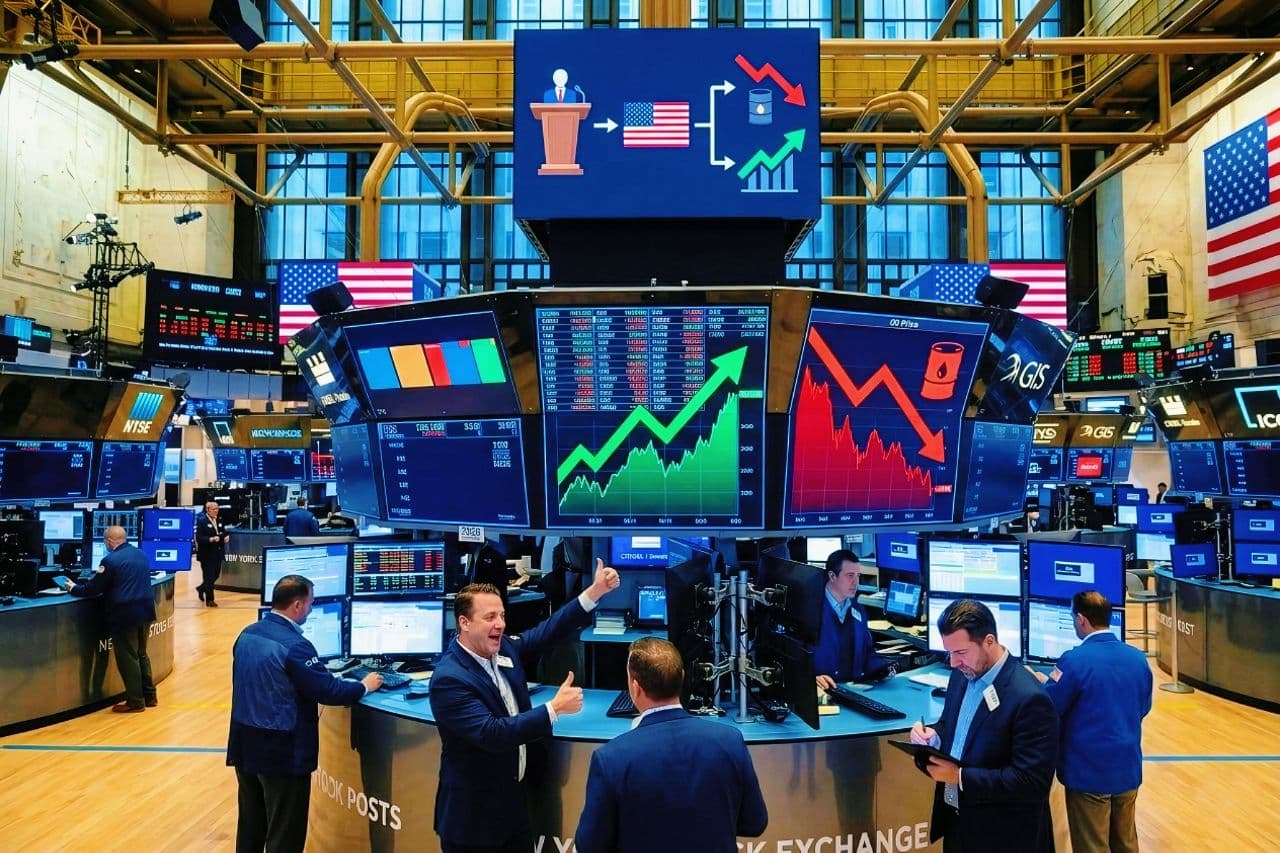
Dow Falls 325 Points After Record; Tech Stocks Plunge, Gold & Silver Rebound
- Major U.S. indexes plunged as tech shares sold off sharply.
- The Dow Jones hit an all-time high earlier in the session but later shed 325 points, erasing gains.
- The S&P 500 and Nasdaq also fell, reflecting broad weakness in technology stocks.
- Gold and silver rebounded after last week’s steep declines, showing renewed safe-haven demand amid market volatility.
- The sharp drop in tech highlights ongoing concerns about valuations and sector resilience.
- The rebound in gold and silver suggests investors are hedging against uncertainty, balancing risk between equities and safe-haven assets.
Key Takeaways
Dow Falls 325 Points After Record; Tech Stocks Dive, Gold & Silver Rally
Major U.S. indexes tumbled Tuesday as technology shares dragged markets lower. The Dow Jones briefly hit a new all-time high before reversing course, closing down 325 points. The Nasdaq dropped 2.1% and the S&P 500 fell 1.3%, erasing early gains. Yesterday’s strong start to the month with the Dow up 515 points was quickly overshadowed by renewed selling pressure in tech.
The Magnificent Seven stocks mostly declined, with Nvidia sliding 4%, while Palantir surged 6% after strong earnings. Gartner was the worst performer in the S&P 500, plunging 22% on weak guidance. Post-earnings moves were mixed: DaVita soared 18%, Teradyne jumped 11%, PepsiCo rose 3.5%, Merck gained 2.5%, while PayPal plummeted 20% and Pfizer fell 3.5%. Disney slipped less than 1% after naming Josh D’Amaro as its new CEO, and Walmart climbed 2.5% to join the $1 trillion market cap club.
Gold and silver futures rebounded sharply, with gold up 6.5% to $4,960 and silver soaring 10% to $84.75. Crude oil rose 2% to $63.40 a barrel, Bitcoin recovered to $74,900 after dipping below $73,000, and the U.S. dollar index slid to near four-year lows. Treasury yields ticked slightly lower, with the 10-year at 4.27%.






SpaceX Merges With xAI; $1.25 Trillion Valuation Sparks Tesla Speculation
Elon Musk confirmed that SpaceX has acquired his AI company xAI, which also owns social platform X, creating a mega entity valued at $1.25 trillion. Musk outlined an ambitious mission: deploying satellites to harness solar power for AI-driven applications, aiming to accelerate humanity’s technological future beyond Earth’s resource limits.
The merger has reignited investor speculation about Tesla’s role in Musk’s expanding empire. With SpaceX already expected to pursue the largest IPO in history, analysts are debating whether Tesla now positioned as both an EV and robotics company could eventually be folded into this new structure. The deal also fuels discussions about space-based data centers and the broader integration of AI with aerospace innovation.






Palantir Stock Surges on Earnings Beat; Software Peers Struggle
Palantir shares jumped more than 5% Tuesday after the company crushed earnings estimates, with Citigroup analysts crediting its “best-in-class” AI capabilities. The rally made Palantir one of the top gainers in the Nasdaq 100, even as the broader index slumped on heavy selling in technology stocks. The strong results reassured investors that AI is more of an opportunity than a threat for Palantir, prompting Bank of America to call the performance “a warning to peers” that real results must back AI claims.
Despite Palantir’s momentum, the broader software sector remained under pressure. The iShares Expanded Tech-Software ETF fell more than 5% as major players like Intuit, ServiceNow, Adobe, Workday, and Atlassian each dropped over 7%. Palantir’s rebound contrasts sharply with peers, highlighting how execution in AI-driven analytics can separate winners from laggards in a challenging market.






Paying Off Student Loans Early: Credit Score Impact Explained
If you’ve received an inheritance and are considering using it to clear student loans, the long-term financial benefits outweigh short-term concerns. While some borrowers worry about a dip in their credit score after paying off debt, TransUnion notes that any change is minimal and temporary. Eliminating monthly payments and saving thousands in future interest is a far stronger advantage than a brief fluctuation in your score.
The reason scores may shift is tied to how credit models work. Once a loan is paid off, the account closes, which can reduce your credit mix and lower the average age of active accounts. If your student loan was your only installment debt or had been open for many years, this closure may cause a slight dip. Still, carrying less debt ultimately strengthens your financial position and outweighs the short-term impact.






Child Care Costs Surge, Consuming 20% of Family Income
Families are increasingly burdened by rising child care expenses, with many spending more on daycare and preschool than on their mortgage. Prices have climbed 4.8% over the past year, outpacing overall inflation at 2.7%. A Care.com survey revealed that parents now allocate about 20% of their annual income to child care, forcing them to cut back on vacations, entertainment, and even dip into savings.
Care.com CEO Brad Wilson warned that the growing financial strain could push more parents to reduce work hours or leave the workforce entirely, deepening both financial and emotional stress. For one infant, families spent an average of $1,328 per month in 2025, while two children in daycare cost $2,340 monthly exceeding the $2,225 average mortgage payment for homeowners who moved in 2024.






Homeownership Costs Soar: Buying a House Now Requires Nearly Double Annual Income
Buying a home in a major city has become far more expensive, with Goldman Sachs economists finding that a down payment plus the first year of mortgage payments now consumes between 160% and 200% of annual income for many buyers. That’s nearly double the burden compared to 2000, when the cost ranged from 90% to 120%. For lower-income households, the challenge is even steeper, making homeownership increasingly out of reach.
Renters face mounting pressure too. Average rent now eats up 32% of income, compared with 27% a generation ago. For the lowest fifth of earners, rent consumes 55% of income, underscoring how housing costs whether renting or buying are straining household budgets more than ever before.






AMD Earnings Could Spark 8% Stock Swing, Traders Say
Advanced Micro Devices is set to report earnings after Tuesday’s closing bell, and traders are bracing for a sharp move. Options pricing indicates AMD stock could shift nearly 8% in either direction by week’s end. From Monday’s close at $246, such a swing could lift shares back toward October’s record highs near $265 or pull them down to around $228.
Bank of America analysts expect AMD’s results to beat Street estimates, citing strength in its data center segment. With Big Tech continuing to pour billions into AI infrastructure, AMD’s positioning in the chip market could prove pivotal for its next leg higher.






Novo Nordisk Stock Plunges 13% as Wegovy Maker Warns of 2026 Sales Decline
Novo Nordisk shares dropped more than 13% Tuesday after the company projected adjusted profit and sales growth to fall between 5% and 13% in 2026. Despite expectations for continued global GLP-1 market expansion, the drugmaker cited lower realized prices in the U.S. under the MFN agreement and looming loss of exclusivity for its semaglutide molecule in certain international markets.
The Danish pharmaceutical giant, best known for its weight-loss drug Wegovy, has seen its U.S.-listed shares tumble about 38% over the past year. In 2025, Novo Nordisk reported 10% net sales growth and 6% operating profit growth, but investors are now punishing the stock as concerns mount over pricing pressures and future profitability.






PayPal Stock Crash: New CEO Named Amid Earnings Miss
PayPal shares plunged more than 18% Tuesday after the company’s fourth-quarter results fell short of Wall Street expectations. Revenue came in at $8.68 billion with adjusted earnings per share of $1.23, both missing analyst forecasts. The sharp decline pushed PayPal stock to its lowest level since early 2017, making it one of the worst performers in both the Nasdaq and S&P 500. Over the past year, shares have lost nearly half their value, underscoring investor concerns about the company’s growth trajectory.
The payments giant also announced a leadership shake-up, naming Jamie Miller as interim CEO. Miller acknowledged that PayPal’s execution has lagged, particularly in branded checkout operations, where the company has struggled against U.S. retail weakness, international headwinds, and tough comparisons in high-growth sectors. The disappointing results and cautious outlook highlight the challenges facing PayPal as it works to regain momentum in the competitive fintech landscape.






Palantir Stock Surge: AI Earnings Beat Sparks Investor Confidence
Palantir shares jumped 6.5% in early trading Tuesday, reversing a three-month slide and clawing back year-to-date losses. The AI-driven software company’s stock climbed near $159, after closing 2025 just under $178, signaling renewed momentum in the tech sector. The rally followed the release of stronger-than-expected quarterly results and an upbeat sales outlook, which reassured investors that Palantir’s growth story remains intact despite broader market volatility.
CEO Alex Karp’s confident letter to shareholders added fuel to the rally, emphasizing Palantir’s resilience in the face of AI disruption concerns. The earnings beat and bullish guidance suggest that not all software stocks are destined to be overshadowed by AI competitors, giving investors reason to believe Palantir can sustain its leadership in data-driven enterprise solutions.






Disney Stock Reaction: Josh D’Amaro Named New CEO After Iger
The Walt Disney Co. announced Tuesday that Josh D’Amaro, Chairman of Disney Experiences, will succeed longtime CEO Bob Iger. The leadership transition becomes official at the company’s annual meeting on March 18. Reports from Bloomberg and The Wall Street Journal had already suggested D’Amaro was the frontrunner, with Iger signaling to close associates that he planned to step down before his contract expired at the end of 2026.
Despite better-than-expected earnings, Disney shares fell 7.4% Monday as investors weighed succession uncertainty. Following the official announcement, shares advanced 1% in premarket trading, reflecting cautious optimism. Iger noted during the earnings call that Disney is “in much better shape today than it was three years ago,” highlighting both the company’s turnaround efforts and new opportunities ahead. The appointment of D’Amaro marks a pivotal moment for Disney as it navigates leadership change and investor expectations in the entertainment industry.






Savings Account Reality Check: Inflation Eats Away at Idle Cash
Keeping money in a savings account may feel safe, but low interest rates mean your balance is quietly shrinking in real terms. With the national average savings rate at just 0.39% APY in early 2026, accounts earning below 2% or 3% are losing purchasing power against inflation and rising living costs. While a savings cushion is essential for financial health, relying solely on traditional accounts can leave you exposed to long-term wealth erosion.
Savings accounts do offer liquidity and FDIC insurance protection up to $250,000 per depositor, making them reliable for emergencies. However, the opportunity cost is significant. Parking $10,000 at 0.50% interest yields only $50 in a year, while inflation at 2.5% erodes more than $1,200 in value. The trade-off is clear: avoiding market volatility comes at the expense of guaranteed loss in purchasing power. Smarter alternatives, such as high-yield savings accounts or diversified investments, can help preserve and grow wealth over time.






High-Yield Savings Accounts: Why 5% APY Still Exists After Fed Cuts
Despite three Federal Reserve rate cuts last fall totaling 0.75 percentage points, the nation’s top savings account rate remains at 5.00% APY. That benchmark was already in place before the first cut in September and has held steady through subsequent reductions in October and December. While the broader savings market has softened, the very highest-yield accounts continue to defy the downward trend, offering savers a rare opportunity to lock in strong returns.
The middle tier of high-yield accounts has slipped, however. As of today, the 10th-best savings rate stands at 4.20%, while the 15th-best has dropped to 4.02%. Just months ago, before the Fed’s first 2025 cut, those same accounts offered 4.40% and 4.31%, respectively 20 to 30 basis points higher. This divergence highlights how competitive banks at the top of the market are holding firm at 5%, while midrank options have gradually eroded, leaving savers to weigh whether a slightly lower “no-strings” option may be more practical than chasing the absolute peak rate.






Inheriting a Home: The Hidden Costs of the Great Wealth Transfer
The “Great Wealth Transfer” is underway, with $124 trillion expected to pass to heirs by 2048, according to Cerulli Associates. For many Americans, that inheritance may include a family home. While receiving property can feel like a blessing, it often comes with financial and logistical challenges that limit its true value. Maintenance costs, property taxes, and market conditions can quickly erode the perceived wealth of inheriting real estate.
A Freddie Mac survey from late 2024 found that three-quarters of Baby Boomer homeowners plan to leave their home or its sale proceeds to family members. This means millions could soon find themselves managing inherited properties. While the emotional connection to a family home is strong, the reality is that inheriting real estate doesn’t always translate into financial security. For heirs, the decision to keep, sell, or rent the property will determine whether the inheritance becomes a burden or a genuine wealth-building opportunity.






Walmart vs. Target: New CEOs Face Divergent Challenges
Two of America’s biggest retailers welcomed new CEOs on Sunday, but their missions couldn’t be more different. At Target (TGT), Michael Fiddelke steps in with the urgent task of reviving sluggish sales and restoring investor confidence. The company has endured four straight quarters of revenue declines, with discretionary spending slowing and merchandising missteps weighing heavily. Target’s slower rollout of delivery systems compared to competitors has also hurt its ability to capture online shoppers, leaving shares down more than 20% over the past year.
Meanwhile, Walmart (WMT) appointed John Furner to continue building on its momentum. His focus is on sustaining customer growth and keeping investors satisfied, as Walmart remains in a stronger position relative to its rival. Analysts note the contrast: Target requires reinvention to regain its footing, while Walmart’s path is one of continuation. The leadership changes highlight the different junctures each retailer faces in navigating consumer trends, investor expectations, and competitive pressures in the retail sector.






The Bottom Line
The Dow Jones briefly reached an all-time high before tumbling 325 points, while the Nasdaq sank 2.1% and the S&P 500 fell 1.3% as tech stocks dragged markets lower. Heavy selling in names like Nvidia and PayPal underscored investor unease, though Palantir’s surge offered a rare bright spot.
Meanwhile, gold and silver rebounded sharply, with gold up 6.5% and silver soaring 10%, signaling a flight to safe-haven assets. Oil prices also recovered, while Bitcoin remained volatile. The takeaway: investors are rotating out of growth-heavy tech into commodities and defensive plays, highlighting caution amid market uncertainty.