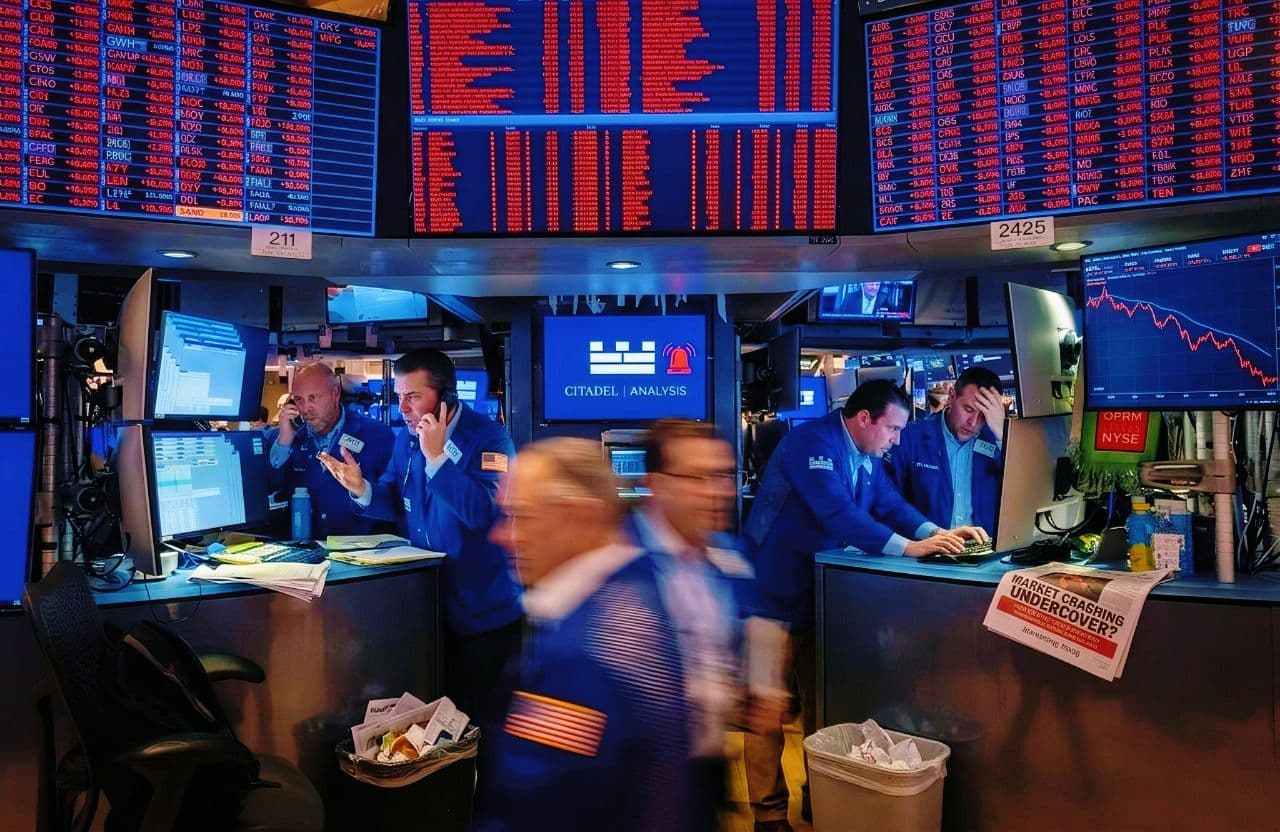
Dow Jones Flat as Fed Holds Rates; S&P 500 Tops 7000 Ahead of Big Tech Earnings
- Major U.S. stock indexes closed little changed Wednesday after the Federal Reserve voted 10-2 to keep interest rates steady at 3% to 3.75%. The S&P 500 briefly hit the 7000 mark for the first time, while the Nasdaq gained 0.3% and the Dow finished nearly flat. Outgoing Fed Chair Jerome Powell noted that the tension between inflation and employment has eased, and advised his successor to “stay out of elected politics.”
- Safe-haven assets surged, with gold futures climbing above $5,385 an ounce and silver jumping more than 10% to $117. The 10-year Treasury yield held near 4.25%, while the U.S. dollar index ticked higher to 96.39 after hitting four-year lows. Bitcoin traded around $89,400, and crude oil futures rose 1.5% to $63.35 a barrel.
- Investors turned their attention to Big Tech earnings, with Microsoft, Meta, and Tesla reporting after the bell. Microsoft shares edged higher, while Meta and Tesla slipped. Apple fell 0.7% ahead of its Thursday earnings release. Nvidia gained 1.6% after Beijing approved sales of its H200 chips to China. Amazon dropped 0.7% after announcing 16,000 layoffs. Post-earnings moves included Seagate (+19%), Texas Instruments (+10%), and AT&T (+4.7%).
Key Takeaways
Dow Jones Today: Fed Holds Rates Steady, S&P 500 Hits 7000, Tech Earnings Drive Market Moves
Major U.S. stock indexes closed little changed Wednesday after the Federal Reserve kept interest rates steady as expected. Earlier in the session, the S&P 500 crossed the 7000 mark for the first time, signaling investor optimism despite policy uncertainty.
The Nasdaq gained 0.3%, while the Dow Jones Industrial Average and S&P 500 ended fractionally mixed after the Federal Open Market Committee voted 10-2 to keep rates at 3% to 3.75%. At a press conference, outgoing Fed Chair Jerome Powell acknowledged ongoing tension between inflation and employment but advised his successor to “stay out of elected politics,” amid criticism from President Donald Trump.
The S&P 500 hit a fresh all-time high for the second straight day, while the Nasdaq neared its October 29 record before retreating. Treasury yields held steady at 4.25%, keeping borrowing costs stable across consumer loans.
Safe-haven assets surged, with gold futures climbing above $5,385 and silver jumping more than 10% to $117, near record highs. The U.S. dollar index ticked up to 96.39 after hitting multi-year lows, while Bitcoin hovered near $89,400. Crude oil futures rose 1.5% to $63.35 a barrel.
Investors focused on Big Tech earnings, with Microsoft edging higher, Meta and Tesla slipping, and Apple falling 0.7% ahead of Thursday’s report. Nvidia advanced 1.6% after Beijing approved sales of its H200 chips to China. Amazon dropped 0.7% after announcing 16,000 layoffs.
Post-earnings moves included Seagate (+19%), Texas Instruments (+10%), and AT&T (+4.7%). Starbucks erased gains to slip 0.6%. UnitedHealth rose 4% while Humana fell 6.7%, following sharp declines tied to Medicare payment proposals.


A sharp rally in used-car retailer Carvana (CVNA) hit a wall Wednesday as shares plunged 15%, wiping out all of their year-to-date gains.
The selloff followed accusations from short-seller Gotham City Research that Carvana had inflated profits to present a false picture of a turnaround and benefit its largest shareholder.
The steep decline pushed Carvana stock toward its lowest closing price since early December, erasing months of momentum in a single session.


Federal Reserve Holds Interest Rates Steady as Inflation and Job Market Concerns Continue
Borrowing costs will remain unchanged for now, with the Federal Reserve shifting back into a wait-and-see mode as it weighs whether inflation or unemployment poses the greater challenge for the U.S. economy.
On Wednesday, the Fed’s policy committee voted to keep its benchmark interest rate flat at 3.5% to 3.75%, pausing after three consecutive quarter-point cuts. The decision passed 10-2, with Governors Stephen Miran and Christopher Waller dissenting in favor of another reduction.
Officials remain split between lowering rates to support a slowing job market and keeping them higher to rein in inflation, which has exceeded the Fed’s 2% target for more than four years.
The committee reiterated its December language, noting it will carefully assess incoming data, the evolving outlook, and the balance of risks before making further adjustments to the federal funds rate.


Tax Savings Boost in 2026 Could Shrink Future Social Security Benefits
Taxpayers filing with the IRS this year are likely to see lower bills or bigger refunds, thanks to permanent tax bracket reductions and expanded deductions under the “One Big Beautiful Bill.” While these savings feel positive now, they carry long-term consequences for Social Security.
The legislation locked in lower tax brackets originally set to expire in 2025, expanded the standard deduction, and added an extra deduction for seniors. Analysts estimate average refunds in 2025 will rise 15% to 20%, delivering short-term relief through refundable credits.
However, the Social Security Administration warns these changes will accelerate depletion of its two main trust funds, moving the exhaustion date forward to early 2034. After that, benefits could be cut by about 20%, reducing retirement income for millions of Americans.


Gold Prices Surge Past $5,300 as Dollar Weakens and Investors Seek Safe-Haven Asset
Spot gold prices rallied past $5,300 on Wednesday, fueled by a sharp drop in the U.S. dollar. The Dollar Index recently hit its lowest level in four years after President Donald Trump’s comments suggested comfort with a weaker currency, adding pressure to the greenback.
Gold’s momentum has been reinforced by heightened geopolitical risks, persistent inflation, rising government debt, and expectations of lower interest rates. Traders are increasingly viewing the dollar’s slide as a possible policy goal of the Trump administration, rather than just market uncertainty.
The surge underscores gold’s role as the dollar’s biggest challenger, with investors flocking to the metal as a hedge against economic and political volatility.


Anthropic CEO Warns AI Could Create Jobless Underclass as Automation Expands
The CEO of Anthropic, a $350 billion AI company, has issued a stark warning about the future of work. Dario Amodei cautioned in a newly released 20,000-word essay that advanced AI systems could leave less-skilled workers with no viable employment options, creating what he described as an “unemployed or very-low-wage underclass.”
Amodei argued that AI’s impact on jobs will move “from the bottom of the ability ladder to the top,” gradually making a wide range of roles obsolete. He emphasized that this shift could permanently reshape the labor market, leaving displaced workers with few alternatives.


.jpg&w=828&q=75)
Nasdaq Nears Record High as AI Stocks Surge Ahead of Big Tech Earnings
The Nasdaq Composite came close to setting a new record Wednesday, lifted by strong earnings tied to the AI infrastructure boom. The index opened 0.7% higher at 23,986, its strongest level since early November, before flattening in later trading. Its last record close of 23,958.47 was set on Oct. 29, just before tech earnings reignited concerns about an AI bubble.
This time, investors appear less worried about overvaluation, focusing instead on the rapid growth of companies powering artificial intelligence. The shift in sentiment has kept demand strong for firms supplying the backbone of AI technology.
A shortage of memory and data storage has boosted results for chip makers like Micron (MU) and storage leaders Sandisk (SNDK) and Western Digital (WDC). At the same time, relentless demand for advanced semiconductors has lifted shares of equipment suppliers Lam Research (LRCX) and Applied Materials (AMAT), reinforcing the sector’s momentum.
Amazon Layoffs 2026: 16,000 Jobs Cut as Company Restructures Corporate Workforce
Amazon announced Wednesday it will eliminate 16,000 corporate positions, following October’s 14,000 job cuts. The move underscores the company’s push to streamline operations and reduce organizational layers.
Beth Galetti, Senior Vice President of People Experience and Technology, said the layoffs are part of efforts to “strengthen our organization by reducing layers, increasing ownership, and removing bureaucracy.”
Galetti emphasized that the timing of the cuts does not signal a new pattern of recurring layoffs but acknowledged that future reductions remain possible. She noted that teams will continue to evaluate their speed, ownership, and capacity to innovate for customers, making adjustments as needed.
Intel Stock Jumps 10% as Nvidia Considers Shifting 2028 Chip Production from TSMC
Intel (INTC) shares surged more than 10% Wednesday, boosted by strong chip sector momentum and reports that Nvidia (NVDA) may redirect some of its 2028 GPU production from Taiwan Semiconductor Manufacturing Co. (TSMC) to Intel. The move would build on Nvidia’s $5 billion investment in Intel last September and hinge on yield improvements for Intel’s next-generation Feynman GPU chip.
Supply chain insiders noted that U.S. manufacturing mandates and tariff pressures have long encouraged American chipmakers to explore deeper collaboration with Intel. The report also suggested Apple (AAPL) is in talks with Intel about producing an entry-level M-series processor for MacBook models currently made by TSMC.
TSMC shares rose more than 1% on the news, with analysts suggesting that potential order diversions could ease regulatory scrutiny and political pressure rather than pose a threat. Intel declined to comment, but its stock has already gained nearly a third in value this year.
Starbucks Stock Rises on Strong Q1 Sales; Next Market Catalyst Expected Thursday
Investors are indeed going “back to Starbucks,” as the company’s turnaround plan continues to show results. The coffee giant reported fiscal first-quarter global and North American comparable-store sales up 4% year-over-year, alongside a 3% increase in transactions, signaling that its strategy to bring customers back into cafes is working.
Shares of Starbucks (SBUX) climbed more than 2% Wednesday following the earnings release, outperforming a broadly quiet market ahead of the Federal Reserve’s interest-rate decision and major tech earnings. The gains pushed Starbucks stock well into market-beating territory for 2026.
At above $100, Starbucks shares are trading significantly higher than their 12-month lows in the $70s, reflecting investor confidence in the company’s turnaround momentum. The next catalyst could arrive Thursday, potentially driving further movement in the stock.
Meta Eyes Paid Subscriptions for Facebook, Instagram, WhatsApp as Social Media Shifts to Premium
You’re one of billions using social media but would you pay for it? That question is becoming more relevant as Meta Platforms (META), parent of Facebook, Instagram, and WhatsApp, prepares to test new subscription plans offering premium experiences across its apps.
According to a TechCrunch report later confirmed by Meta, the plans could include AI-powered features and expanded user controls. The move has sparked speculation that tools currently free may soon sit behind a paywall, reshaping how users interact with the platforms.
Meta is expected to share more details during its upcoming earnings report Wednesday, potentially outlining how subscriptions will fit into its broader strategy.
The shift follows a growing trend among social media peers. Elon Musk’s X (formerly Twitter), Microsoft’s LinkedIn, and Snap’s Snapchat already operate freemium models, offering premium features for paying subscribers while keeping basic access free.
Nvidia Wins China Approval to Sell $10B in H200 AI Chips
Nvidia (NVDA), America’s leading AI chipmaker, is moving closer to expanding sales in China after Beijing granted clearance for major tech firms including ByteDance and Alibaba (BABA) to place orders for its H200 AI chips.
The Wall Street Journal reported Wednesday that the initial approval could allow Chinese companies to purchase hundreds of thousands of chips valued at roughly $10 billion. Nvidia has yet to issue a comment on the development.
Tech Stocks Lift S&P 500 as Intel, Seagate Rally; Amphenol Drops Despite Strong Outlook
For the second consecutive day, technology stocks led the S&P 500 higher. The Information Technology Sector was the strongest of the 11 tracked industries, rising about 0.6% Wednesday morning.
Seagate Technology Holdings (STX), Intel (INTC), and Western Digital (WDC) were standout performers, posting gains of roughly 18%, 9.5%, and 8.5%, respectively, helping to power the sector’s momentum.
Amphenol (APH), however, was the index’s weakest stock, sliding 14% despite reporting solid results and issuing an upbeat forecast.
Overall, six of the 11 sectors traded in positive territory as the S&P 500 edged 0.1% higher in recent action.
Retirees Withdraw Less Than 2% From 401(k) in 2026—Below Morningstar’s 3.9% Safe Rate
Morningstar’s December 2025 research raised its recommended safe withdrawal rate to 3.9%, edging closer to the well-known 4% rule in personal finance. That guideline suggests retirees withdraw 4% of savings in the first year, then adjust annually for inflation to ensure funds last through retirement. But actual retiree behavior shows a far more conservative approach.
A 2025 study in Financial Planning Review by David Blanchett and Michael Finke found married 65-year-olds with at least $100,000 in assets withdraw just 2.1% annually, while single retirees take out only 1.9%. Retirees spend about 80% of guaranteed income like Social Security but tap only half of their retirement savings. Vanguard reports one in four retirees don’t touch their savings at all during the first five years after leaving work.
The result is a paradox: while many fear running out of money, retirees often live more frugally than necessary, potentially missing out on experiences they saved for. For others, however, lower withdrawal rates reflect caution and the math of sustaining retirement with limited resources.
Warren Buffett Says Emotional Intelligence Is the Key to Investment Success
If you’ve ever bought into a market rally only to panic and sell at a loss, you already know how costly emotions can be. With recent volatility dominating headlines, Warren Buffett has remained calm, steadily building a record cash reserve for future opportunities. His steadiness comes from one mindset: emotional intelligence.
At Berkshire Hathaway’s 2025 shareholder meeting his final as CEO Buffett told investors that market drops are “really nothing” if your plan is sound. He emphasized that emotional intelligence is what keeps investors from panic-selling or chasing bubbles, a discipline that has underpinned his decades of success.
Buffett acknowledged that emotions are natural but stressed that they must be “left at the door” when making investment decisions. Even as markets swung this year, he reminded shareholders not to expect the world to change for them, but to stay focused on their strategy.
Emotional intelligence the ability to recognize and manage your own emotions remains the defining trait that separates successful investors from those who follow trends. While analytical skills help with balance sheets, it is emotional discipline that protects portfolios in turbulent times.
New Tax Law Restores 100% Bonus Depreciation, Unlocking Big Savings for Business Owners
Business owners who purchased equipment, property, furniture, or vehicles in 2025 may now deduct the entire cost in a single tax year, thanks to sweeping changes under the “One Big Beautiful Bill.” The legislation is expected to lower tax bills and boost refunds for millions of Americans.
Previously, bonus depreciation allowed only partial deductions, phased down to 40% in 2025 and set for elimination by 2027. The new law reverses that trend, reinstating the full 100% deduction and making it permanent. This means qualified business purchases put into service after January 19, 2025 can be fully written off immediately, rather than spread across multiple years.
Tax experts say the measure represents one of the most significant opportunities for entrepreneurs. Michael Mofsa, founder of Prosperity Tax Advisors, called the restored bonus depreciation “a huge, huge opportunity for taxpayers,” highlighting its potential to deliver substantial savings.
AI Job Displacement Could Extend Unemployment by a Month, Cut Earnings by 4%
Workers displaced by artificial intelligence may face longer and tougher recoveries than others. Goldman Sachs research published this month found that employees in disrupted industries take about one month longer to find new work compared to the median 11.4 weeks for unemployed workers overall.
Even after re-entering the workforce, displaced employees often earn less. Their incomes decline by more than 4% double the rate of other displaced workers according to Goldman’s analysis of “disrupted occupations” from 1990 to 2024. The report warned that these workers face higher risks of long-term unemployment and permanent career disruption.
The challenge could intensify as AI adoption grows. Goldman estimates 6% to 7% of U.S. workers may be displaced by AI in the next decade, with older workers (55+) particularly vulnerable. The Federal Reserve Bank of St. Louis also flagged risks for employees who struggle to adapt to AI under supervisory roles.
Microsoft Earnings Loom: Traders Brace for 5% Stock Swing
Microsoft (MSFT) is set to report quarterly results after Wednesday’s market close, with options pricing signaling a potential 5% move in either direction by week’s end. From Tuesday’s close near $481, shares could climb above $502 or fall toward $459 depending on the outcome.
The stock is down about 11% since October, when Microsoft last reported earnings. At that time, the company beat estimates but revealed plans to significantly ramp up AI infrastructure spending, sparking investor concerns. Shares had closed at a record high of $542 the day before those results.
This quarter, investors will be watching closely for updates on capital expenditures and projections for the “Intelligent Cloud” segment, which includes Azure. With big tech earnings in focus, Microsoft’s results could set the tone for the sector.
Fed Research Shows Dissenting Votes Reduce Future Influence on Policy
A new study from the National Bureau of Economic Research suggests that Federal Reserve policy committee members who vote against the majority may pay a price later. Researchers from UC Berkeley, the Fed, NBER, and Hong Kong University of Science and Technology found that dissenters are about one-third less likely to see their preferred interest rate policy adopted in subsequent meetings.
While most Federal Open Market Committee (FOMC) votes are unanimous, recent meetings have seen dissenting voices some favoring steady rates, others pushing for steeper cuts. Governor Stephen Miran has cast multiple dissenting votes since joining the committee.
The research highlights the chair’s influence in steering consensus and suggests dissenters may be punished for breaking unity. Alternatively, the authors note, dissent may simply reflect recognition that a viewpoint has already lost traction and will not prevail in future decisions.
Consumer Confidence Hits 2014 Low—But Spending Stays Strong
Consumer confidence plunged in January, with the Conference Board’s index falling to its lowest level since 2014. Sentiment surveys show Americans are 20% less optimistic than a year ago, citing worries about jobs, inflation, tariffs, groceries, and health insurance.
Yet despite the gloom, spending remains resilient. Higher-income households continue to drive robust consumption, and economic data still points to expansion. Economists note the disconnect between consumer “vibes” and actual spending behavior.
Wells Fargo analysts Tim Quinlan and Shannon Grein cautioned that confidence readings don’t always align with spending patterns, adding that consumers were more optimistic at the height of the pandemic than they are today.
The Bottom Line
- Fed holds rates steady: The Federal Reserve paused after three straight cuts, keeping borrowing costs at 3.5%–3.75%.
- Dissent carries risks: Research shows Fed members who vote against the majority lose influence in future meetings.
- Markets mixed: The Dow closed little changed, the S&P 500 hit 7,000, and tech stocks led gains.
- Corporate movers: Starbucks rose on strong Q1 sales, Intel surged on chip optimism, while Amphenol sank despite upbeat results.
- Layoffs & labor: Amazon announced 16,000 job cuts, while AI continues to raise concerns about displacement and wage pressure.
- Safe havens & assets: Gold broke past $5,300 as the dollar weakened, highlighting investor demand for hedges.
- Taxes & retirement: New tax breaks could deliver big savings for business owners, but lower rates risk accelerating Social Security depletion. Retirees remain cautious, withdrawing far less than the “4% rule.”
The Fed is signaling caution, markets are balancing optimism in tech with broader uncertainty, and policy changes from taxes to AI are reshaping both corporate strategies and household finances.