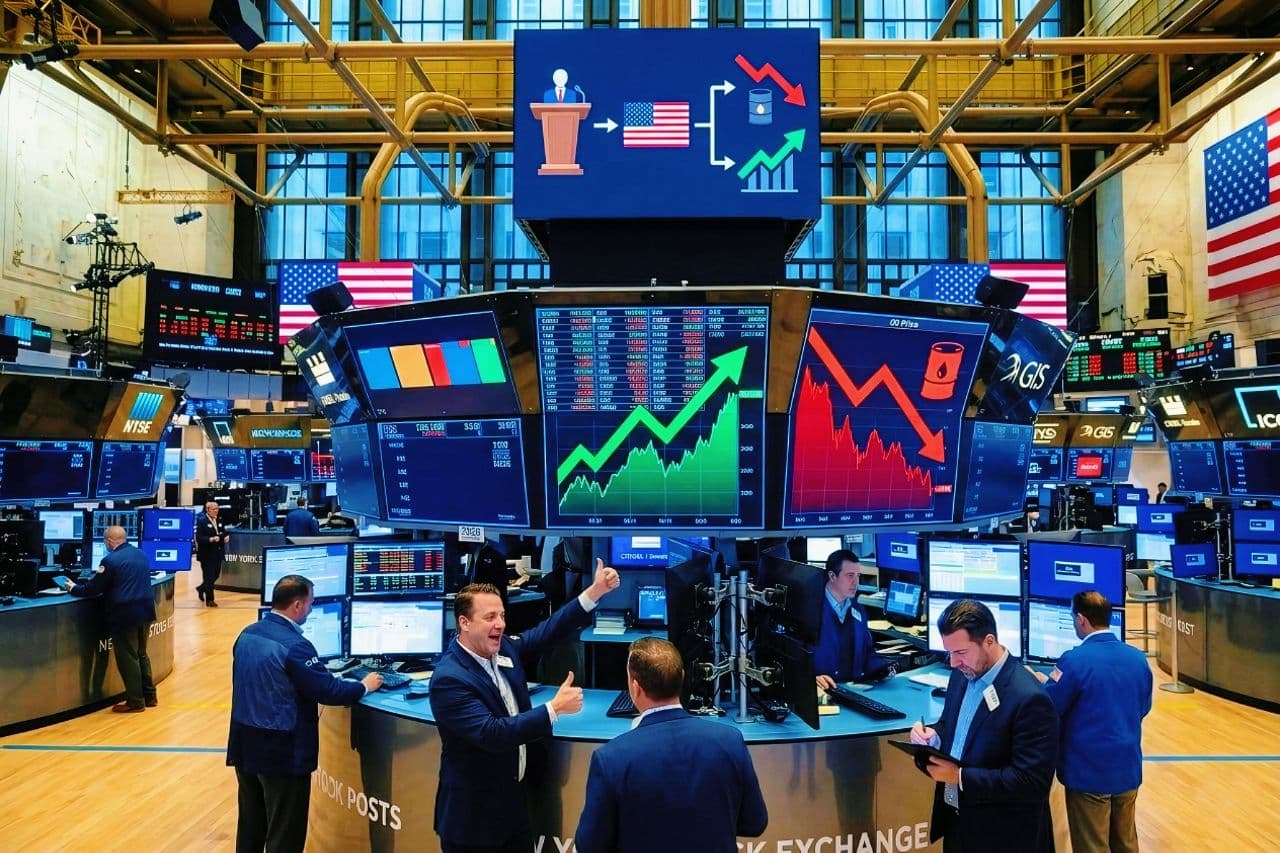
Dow Jones Forecast: Microsoft & Software Stocks Drag Indexes Lower as Oil Prices Surge on US-Iran Tensions
- Major U.S. stock indexes fell Thursday as Microsoft’s 12% plunge and steep declines in software stocks weighed heavily on the Dow Jones, Nasdaq, and S&P 500. Meta surged 10% on strong AI‑driven earnings, while Tesla slipped 3%. ServiceNow, Atlassian, Intuit, and Salesforce all dropped sharply, underscoring investor concerns about cloud growth and AI spending.
- Outside of tech, Southwest Airlines soared 19% after upbeat guidance, Royal Caribbean jumped 17%, and Lockheed Martin gained 5.5%. Meanwhile, oil futures surged 3.5% to $65.50 a barrel amid U.S.-Iran tensions, gold climbed near $5,600 an ounce, and Bitcoin retreated to $83,600 after hitting $89,300 overnight. Apple is set to report earnings after the closing bell, with expectations of record revenue.
Key Takeaways
Stock Market Forecast: Microsoft Plunge & Software Sell-Off Drag Indexes; Oil & Gold Surge Amid Global Tensions
Major U.S. equities fell Thursday as Microsoft’s 12% drop and steep declines in software stocks weighed on the Nasdaq, S&P 500, and Dow Jones. The Nasdaq retreated 1.4%, the S&P 500 slipped 0.6%, and the Dow edged down 0.2%. Microsoft’s earnings beat was overshadowed by slowing cloud growth, while Meta surged 10% and Tesla fell 3%. ServiceNow, Atlassian, Intuit, and Salesforce all posted sharp losses, underscoring investor concerns about AI spending and enterprise software demand.
Post-earnings winners included Southwest Airlines, up 19%, Royal Caribbean, up 17%, and Lockheed Martin, up 5.5%. Apple is set to report after the closing bell, with expectations of record revenue. Meanwhile, safe-haven assets rallied: gold surged near $5,600 an ounce, silver held above $113, and oil futures jumped 3.5% to $65.50 a barrel amid U.S.-Iran tensions. Bitcoin retreated to $83,600 after hitting $89,300 overnight, while Treasury yields eased to 4.23% and the U.S. dollar index fell to its lowest level in over four years.






Tech Stock Forecast: AI Spending vs. Earnings Growth Driving Investor Sentiment
Investors are signaling that raw AI spending is no longer enough they want to see earnings tied directly to those investments. Meta Platforms (META) delivered just that, with fourth‑quarter results showing revenue growth accelerating thanks to its aggressive AI push. Capital expenditures jumped 50% in Q4 2025 and are expected to rise more than 90% this year, far above Wall Street’s expectations. Yet Meta’s ad revenue surged 24%, fueled by an 18% increase in impressions and a 6% rise in average prices, proving that AI is already boosting its core business.
Analysts noted that Meta’s strong top‑ and bottom‑line growth offset skepticism about its heavy spending. Bank of America emphasized that “AI is driving returns, and more for Meta than peers,” while JPMorgan suggested the company has regained credibility to keep investing in AI infrastructure. With Meta forecasting revenue growth up to 33.5% this quarter its fastest pace since 2021 investors are rewarding results that show AI spending is translating into tangible earnings.






Meta Stock Forecast: AI Earnings Beat Fuels S&P 500 Surge & Analyst Upgrades
Meta Platforms (META) shares jumped more than 9% Thursday, hitting year‑to‑date highs after its fourth‑quarter earnings topped Wall Street expectations across all metrics. Investors credited Meta’s aggressive AI investments for driving stronger ad revenue and engagement, making it the only Magnificent Seven stock in positive territory. While peers like Nvidia, Alphabet, Microsoft, Amazon, and Tesla slipped, and Apple clung to small gains ahead of its report, Meta stood out as one of the top gainers in the S&P 500.
Analyst sentiment has turned decisively bullish. All 24 analysts tracked by Visible Alpha rate Meta a “buy,” with a mean price target of $868 implying 20% upside from current levels. Reports highlight Meta’s ability to leverage AI to boost monetization and engagement across its core apps. CEO Mark Zuckerberg emphasized during the earnings call that Meta is balancing new initiatives with heavy AI investment to improve both product quality and business performance, reinforcing confidence in the company’s growth trajectory.






Southwest Airlines Stock Forecast: Profit Outlook Sends Shares Soaring on EPS Guidance
Southwest Airlines (LUV) surged nearly 15% Thursday to lead the S&P 500 after issuing a fiscal 2026 profit forecast that far exceeded Wall Street expectations. The carrier guided for adjusted earnings per share of “at least $4.00,” representing a 330% jump from fiscal 2025’s $0.93. Analysts had expected $3.15, making the outlook a clear beat. The rally pushed Southwest shares up nearly 50% over the past year, underscoring investor confidence in its turnaround strategy.
The airline has recently introduced assigned seating and began charging for checked bags under pressure from Elliott Investment Management, marking significant shifts in its business model. Despite posting $441 million in net income in 2025, Southwest lost money on passenger operations, with costs per available seat mile exceeding passenger revenue. Still, investors are betting that operational changes and stronger demand will drive profitability in 2026, putting Southwest ahead of rivals Delta, United, and American in market momentum.






Microsoft Stock Forecast: Cloud Growth Concerns & AI Spending Pressure Trigger Sharp Sell-Off
Microsoft (MSFT) shares tumbled nearly 12% to around $425 in Thursday trading, leading losses on the Dow Jones Industrial Average and Nasdaq. The decline came despite quarterly revenue and earnings beating analyst estimates, as investors focused on slowing Azure cloud growth, rising AI infrastructure spending, and reliance on a few large customers. Microsoft also revealed that nearly half of its backlog is tied to OpenAI, raising concerns about concentration risk and the company’s exposure to a single partner.
Morgan Stanley analysts noted that Azure growth narrowly beat guidance but fell short of broader Wall Street expectations, reinforcing worries about Microsoft’s ability to sustain momentum in its cloud business. While most analysts remain bullish long term, the near-term sell-off reflects investor skepticism about whether heavy AI spending will translate into earnings growth quickly enough to justify the costs.






Dollar Forecast: 4-Year Low Sparks Inflation Concerns & Investor Shift to Safe Havens
The U.S. dollar index fell to 96, its lowest level in four years, marking an 11% decline over the past year. For consumers, a weaker dollar translates into higher import prices, rising fuel costs, and potentially steeper interest rates on mortgages, car loans, and credit cards. The slide stems from multiple factors: three Fed rate cuts in late 2025, persistent inflation worries, geopolitical tensions over Greenland and trade policy, questions about Fed independence, and speculation of U.S.-Japan currency intervention to support the yen.
Analysts warn that the dollar’s weakness has triggered what they call the “Sell America” trade, where investors simultaneously exit U.S. stocks, bonds, and dollars. Gold surged past $5,500 an ounce, up 20% year-to-date, as investors seek safe-haven assets once represented by the dollar. While the greenback remains the world’s primary reserve currency under the Bretton Woods framework, its recent decline underscores growing uncertainty about U.S. economic stability and global investor confidence.






Tech Stock Forecast: S&P 500 Declines as Microsoft, ServiceNow & First Solar Lead Losses
The S&P 500 Information Technology Sector was the worst performer Thursday, sliding 3.5% and dragging the broader index down 1%. Microsoft (MSFT), First Solar (FSLR), and ServiceNow (NOW) each posted double‑digit losses, while another six tech names fell at least 7%. The sharp sell‑off in tech overshadowed gains in other industries, underscoring investor concerns about cloud growth, AI spending, and sector volatility.
IBM (IBM) was the lone standout, rising 6% and bucking the broader trend. While only four of the 11 sectors tracked by the S&P 500 were in the red, the magnitude of the tech sector’s decline weighed heavily on overall market performance, highlighting the outsized influence of technology stocks on benchmark indexes.






Buffett & Munger’s Portfolio Strategy: Preparing for a 50% Market Drop
Charlie Munger’s timeless investing principle is blunt but powerful: if you can’t stomach a 50% decline in your portfolio, you’ll never achieve exceptional results. Alongside Warren Buffett, Munger emphasized that enduring steep market corrections is part of the long‑term investor’s journey. History backs this up during the 2008 financial crisis, Berkshire Hathaway’s shares lost more than half their value, just like many other high‑quality companies.
The lesson is clear: volatility is inevitable, and resilience is essential. Munger’s philosophy forces investors to confront their true risk tolerance. As financial planner Taylor Kovar put it, “A 50% drop isn’t fun, but it’s part of investing. If you’re going to stick with it long enough to see real growth, you’ve got to be able to stay in when things get rough.”
Key Takeaways for Investors
- Expect steep declines: Market drops of 50% happen two or three times a century.
- Resilience matters: Exceptional returns require enduring volatility without panic selling.
- Risk tolerance check: Munger’s rule is a test of whether you’re fit to be a shareholder.
- Long-term focus: Staying invested through downturns is the path to compounding wealth.






Salary Benchmark Forecast: Average Pay by Age Group & Career Growth Insights
When you’re deep into the routine of a new job, it’s easy to overlook how your paycheck compares to others. Yet asking whether your salary is competitive for your age group can provide clarity on your career trajectory and financial progress. Transparency with colleagues about pay can also help you gauge where you stand in the broader labor market.
For younger workers, earnings typically start at the lowest point of a career. Entry-level salaries can feel restrictive, but they are a stepping stone toward higher compensation as experience builds. According to the Federal Reserve Bank of St. Louis, the median weekly wage for individuals aged 16 to 24 is $771, which translates to $40,092 annually. This benchmark offers a baseline for evaluating whether your income aligns with national averages and highlights the importance of long-term growth.






Las Vegas Sands Stock Forecast: Macao EBITDA Miss Sends Shares Lower Despite Strong Singapore Results
Las Vegas Sands (LVS) reported fiscal 2025 fourth‑quarter results that beat expectations on both revenue and earnings per share, yet the stock fell 6% in pre‑market trading. The decline was driven by disappointment in Macao, where adjusted property EBITDA came in at $608 million, missing consensus estimates of $628 million. CEO Robert Goldstein acknowledged the shortfall on the earnings call, noting that performance in the region did not meet expectations.
By contrast, the company’s Marina Bay Sands property in Singapore delivered stronger results, with adjusted EBITDA of $806 million versus forecasts of $692 million. Overall, Las Vegas Sands posted adjusted EPS of $0.85 on revenue of $3.65 billion, both above analyst estimates. Despite Thursday’s drop, shares remain up more than 40% over the past year, reflecting investor optimism about the company’s broader recovery trajectory.






Financial Literacy Forecast: Survey Shows Pop Culture Knowledge Outpaces Saving Skills
A new survey of 2,000 Americans commissioned by LendingClub and conducted by Talker Research revealed that reality TV drama ranked highest in perceived expertise at 6.4 out of 10, followed by social media trends and DIY projects at 6.0, and trending music at 5.9. Interest rates scored 5.7, but saving money came in last at just 3.9. This gap highlights the urgent need for stronger financial literacy, as misconceptions about savings accounts can quietly erode household stability.
The findings show that saving isn’t just a long-term goal it directly impacts daily financial decisions, from where cash is stored to how prepared families are for unexpected expenses. Alarmingly, while 79% of respondents have a savings account earning interest, 43% don’t know the actual rate. This lack of awareness underscores how cultural fluency in entertainment often overshadows essential money management skills, costing Americans in ways they may not immediately recognize.






Housing Market Forecast: Buying Beats Renting in Most Counties, But Upfront Costs Hold Buyers Back
A new report from real estate data firm ATTOM shows that in 57% of U.S. counties, owning a three‑bedroom home is cheaper than renting one. While this highlights the long‑term affordability of homeownership, many potential buyers remain stuck in rentals due to the steep upfront costs of purchasing a property. Rising home prices, which have now climbed for 30 consecutive months according to the National Association of Realtors, continue to make the initial investment a major barrier.
ATTOM CEO Rob Barber noted that while buying is typically the most affordable option over time, record‑high housing prices are challenging affordability for first‑time buyers. Updated figures show that typical buyers earn around $109,000 annually, underscoring the income levels currently needed to enter the market. Despite the financial advantage of owning versus renting, the gap between household earnings and upfront costs remains the key obstacle for many Americans.






Dow Stock Forecast: 4,500 Layoffs Announced in ‘Transform to Outperform’ Cost-Cutting Plan
Dow Inc. (DOW) unveiled its fiscal 2025 fourth‑quarter results alongside a sweeping “Transform to Outperform” initiative aimed at radically simplifying operations. The plan includes about 4,500 layoffs and is designed to reset the company’s cost structure while modernizing customer service. Dow expects the strategy to add at least $2 billion in near‑term operating EBITDA, leveraging AI and automation to boost productivity and shareholder returns.
The restructuring will carry one‑time costs of $1.1 billion to $1.5 billion, with $600 million to $800 million tied to severance. CEO Jim Fitterling emphasized that the program will accelerate Dow’s push to address prolonged industry challenges and maintain global leadership. For the quarter, Dow reported an adjusted loss of $0.34 per share on $9.46 billion in sales, slightly better than analyst expectations. Shares fell 2.5% before the bell and remain down about one‑third over the past year.






Apple Stock Forecast: Traders Brace for 4% Swing After Earnings Report
Apple (AAPL) is set to release its fiscal first‑quarter earnings after Thursday’s closing bell, with traders pricing in a notable move. Options activity suggests the stock could shift about 4% in either direction by week’s end. From Wednesday’s close near $256, that implies a potential climb to $266 still 7% below December’s record or a drop to around $247.
The iPhone maker is expected to post record holiday quarter revenue, driven by strong demand for the iPhone 17 and positive signals in the global smartphone market. Apple shares remain about 11% below their early December highs, but the company’s last earnings report in October beat estimates, with CEO Tim Cook highlighting momentum toward its best‑ever holiday season. Investors are now watching closely to see if Apple can sustain that trajectory.






Tesla Stock Forecast: Musk Ends Model S & X to Pivot Toward AI and Robotics Future
Tesla (TSLA) CEO Elon Musk announced Wednesday that the company will discontinue production of its Model S sedan and Model X SUV by mid‑2026. The move will narrow Tesla’s consumer lineup to the Model 3, Model Y, and Cybertruck, while progress continues on a new high‑end Roadster. Musk described the decision as “slightly sad” but emphasized it as part of Tesla’s broader shift toward an autonomous future.
The transition reflects Musk’s ambition to reposition Tesla beyond cars, focusing on autonomous driving, robotics, and artificial intelligence. Tesla’s auto deliveries fell year‑over‑year in 2025, and Musk aims to begin scaling production of Optimus robots this year. Fremont factory space currently dedicated to the S and X models will be repurposed for robotics manufacturing, underscoring Tesla’s pivot from traditional EV production to advanced technology development.






The Bottom Line
Major U.S. stock indexes fell Thursday as Microsoft’s sharp 12% drop and widespread software sector losses weighed heavily on the market. The Nasdaq slid 1.4%, the S&P 500 lost 0.6%, and the Dow dipped 0.2%. Despite strong earnings beats from Meta and Southwest Airlines, tech weakness dominated sentiment. Meanwhile, safe‑haven assets surged gold neared $5,600 an ounce and silver held above $113 while oil futures jumped 3.5% to $65.50 a barrel amid escalating U.S.-Iran tensions. The dollar index slipped to 96.28, its lowest in four years, adding to investor unease.