Dow Jones Jumps as Unemployment Rate Falls – S&P 500 Hits Record High
- Stock Indexes Surge: The Dow Jones and other major indexes jumped Friday after the unemployment rate fell more than expected.
- S&P 500 Record High: The S&P 500 hit a new all-time high, reflecting strong investor confidence.
- Labor Market Impact: The drop in unemployment reassured markets that the U.S. economy remains resilient despite slower job growth.
- Investor Sentiment: Traders interpreted the report as a sign the Federal Reserve may hold rates steady, fueling optimism across equities.
Key Takeaways
Dow Jones and S&P 500 Rally as Unemployment Falls – Intel, Meta Deals, and Market Movers
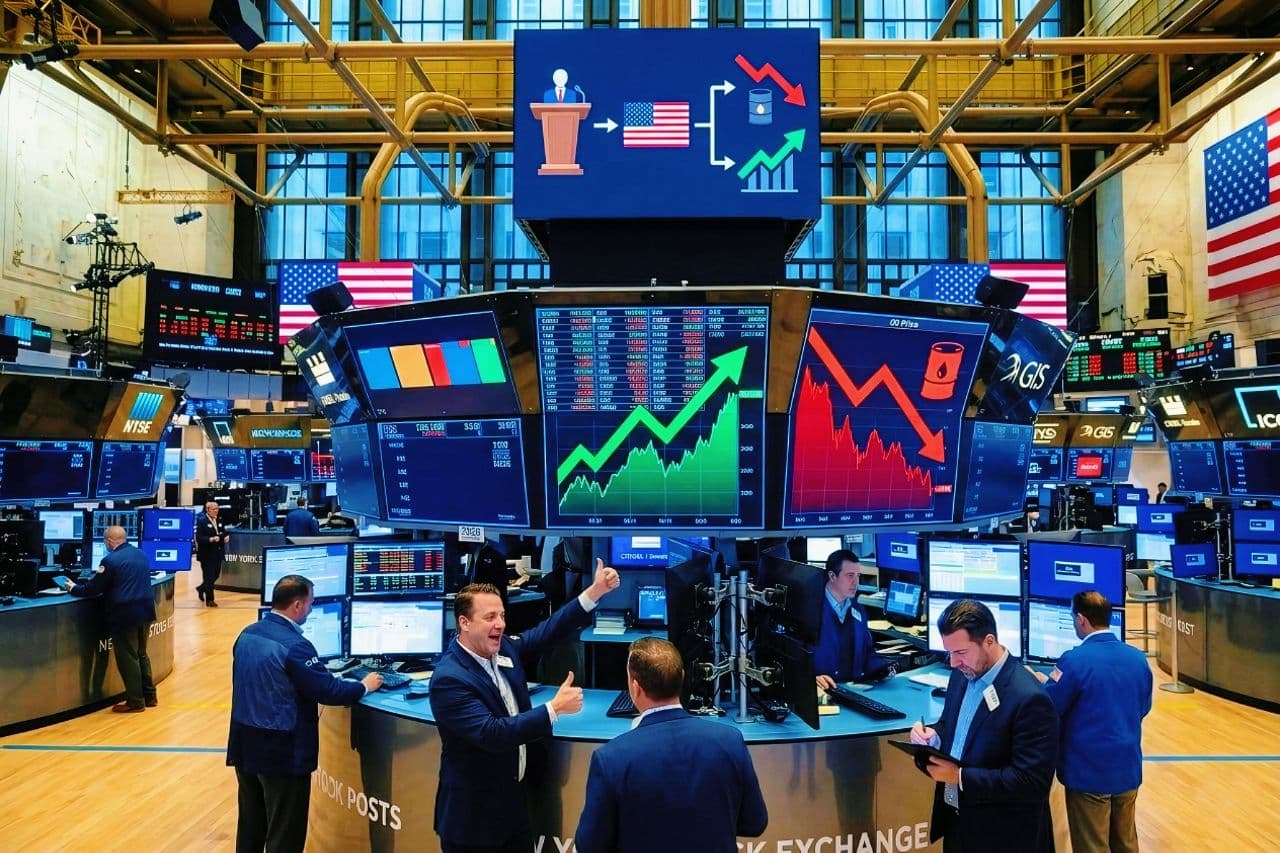
Major U.S. stock indexes surged Friday, with the S&P 500 hitting a new all-time high after the unemployment rate fell more than expected in December. The Nasdaq gained 1%, the S&P 500 rose 0.8%, and the Dow added 0.5%, positioning all three benchmarks for solid weekly gains.
The Bureau of Labor Statistics reported 50,000 jobs added in December, below forecasts of 73,000 and weaker than November’s revised 56,000. Still, the unemployment rate dropped to 4.4% from 4.6%, beating expectations of 4.5%. Treasury yields held steady, with the 10-year at 4.17%, while the Supreme Court delayed a ruling on Trump’s tariffs, leaving trade policy uncertainty in place.
Commodities rallied, with West Texas crude up 2.8% to $59.35 and gold climbing 1.1% to $4,510. Bitcoin hovered near $90,800, while the U.S. dollar index edged higher to 99.11. Corporate headlines added momentum: Meta’s nuclear energy deals lifted Oklo (+8%) and Vistra (+10%), Intel surged 10% after Trump praised CEO Lip-Bu Tan, while GM fell 3.5% on a $6B EV charge. Rio Tinto dropped 3.5% amid merger talks with Glencore, whose shares soared in London. Alphabet rose 1.5%, overtaking Apple in market cap at nearly $4 trillion, second only to Nvidia.


Homebuilder and Building Materials Stocks Surge as Trump Orders $200B Mortgage Bond Buy
Shares of building materials companies and homebuilders rallied sharply to close the week after President Trump directed his representatives to purchase $200 billion in mortgage bonds. The move, announced on Truth Social, was framed as a way to lower mortgage rates, reduce monthly payments, and make homeownership more affordable.
Builders FirstSource (BLDR) led gains in the S&P 500 with an 11% jump, while homebuilders Lennar (LEN), PulteGroup (PHM), and D.R. Horton (DHI) advanced between 7% and 8%. The iShares U.S. Home Construction ETF (ITB) also climbed nearly 6%, reflecting broad investor enthusiasm across the housing sector.


Intel Stock Surges After Trump Praises CEO Lip-Bu Tan – Government Stake Fuels Investor Confidence
Intel’s stock climbed to its highest level in nearly two years Friday, jumping close to 10% after President Trump praised CEO Lip-Bu Tan in a Truth Social post. The chipmaker became one of the best-performing stocks in the S&P 500, with investors reacting strongly to Trump’s remarks that the U.S. government is “proud” to be an Intel shareholder.
The endorsement marks a sharp reversal from last summer, when Trump had called for Tan’s resignation over concerns about his ties to Chinese companies. After meeting with Tan in August, Trump shifted course and helped broker a deal that gave the U.S. government a 10% stake in Intel, a move that has since bolstered investor confidence in the company’s turnaround.


Small-Cap Stocks Poised to Outperform – Expert Tips, Earnings Rebound, and Market Outlook
The stock market’s smaller players may finally be ready to lead. Small-cap companies, typically valued between $250 million and $2 billion, are showing early strength in 2026. The S&P 600 and Russell 2000 indexes have already risen more than 4% year-to-date, outpacing the broader market and fueling optimism that small-caps could outperform their larger peers.
Analysts note this isn’t the first time small-caps were expected to shine, but this year conditions look more favorable. Earnings are projected to rebound, monetary policy is more supportive, and the potential removal of tariffs could provide additional tailwinds. Bank of America strategist Jill Carey Hall emphasized that “earnings outperformance should drive small caps to lead,” highlighting a list of 30 smid-cap stocks with average upside near 30%. Roughly 90% of those names have seen positive earnings-per-share revisions in recent months, with median growth projections of 23% over the next year.


ACA Premiums Spike – Affordable Health Insurance Alternatives Before Jan. 15 Deadline
As open enrollment for Affordable Care Act plans nears its close, many individuals are grappling with steep premium hikes and searching for cheaper alternatives outside the Health Insurance Marketplace. Boulder, Colorado resident Rebecca Rush experienced significant sticker shock during the 2026 enrollment season.
Her Bronze plan, which carried a $9,500 deductible, was set to rise from $760 to $1,001 per month one of the more affordable marketplace options available. Frustrated by rising costs and mounting out-of-pocket expenses, Rush welcomed the outreach of a private broker and, for the first time since the ACA’s launch in 2013, opted for an off-market plan.


ACA Subsidy Cliff Returns – How to Lower Income and Avoid Losing Health Insurance Tax Credits
Premiums for Affordable Care Act health plans are rising again in 2026 as enhanced tax credits expired at the start of the year. These temporary subsidies, introduced in 2021, had reduced costs for individuals earning above 400% of the federal poverty level about $62,600 in 2025. Without them, many off-exchange buyers are facing higher premiums and the risk of a steep tax bill.
Financial planners warn that those with a modified adjusted gross income (MAGI) just above the 400% threshold could lose all subsidies, a scenario dubbed the “subsidy cliff.” Simple strategies such as increasing 401(k) contributions or using a health savings account (HSA) can lower taxable income enough to remain eligible for credits. As Carolyn McClanahan of Life Planning Partners explained, “If that number is $1 above the threshold, you lose the tax credit.”


Earnings Season Trading Strategy – Goldman Sachs Recommends Options as Volatility Looms
Earnings season is approaching, and Goldman Sachs analysts are urging traders to consider options. Current pricing suggests the average S&P 500 stock will move about 4.5% after earnings, near the lowest implied volatility in two decades. Just two quarters ago, earnings swings averaged 5.4%, the highest since 2009. Goldman argues that while expectations point to a calmer season, the fundamental drivers of volatility remain intact.
At the sector level, Goldman sees the greatest potential for post-earnings volatility in utilities, healthcare, materials, and industrials, with utilities standing out for their abnormal swings in recent quarters. Tech, by contrast, has seen volatility decline over the past year. Goldman expects more upside than downside overall, noting that S&P 500 earnings estimates have risen 5% and their price target increased 8% in the past three months, while the index itself gained just 3%. This gap suggests fundamentals are improving faster than stock prices.


Nuclear Energy Stocks Surge as Meta Strikes Power Deals With Vistra, Oklo, and TerraPower
Several nuclear energy stocks soared Friday morning after Meta Platforms (META), parent of Facebook and Instagram, announced new agreements with Vistra Corp. (VST), startup Oklo (OKLO), and Bill Gates-backed TerraPower. Vistra will supply power from its existing reactors, while Oklo and TerraPower will develop smaller nuclear reactors expected to come online between 2030 and 2035. Meta projects these partnerships will add 6.6 gigawatts of capacity to its data center network by 2035, though financial terms were not disclosed.
Shares of Vistra and Oklo surged nearly 14% following the announcement, while other nuclear energy names including NuScale Power (SMR), Constellation Energy (CEG), and Nano Nuclear Energy (NNE) also posted gains. Meta’s stock was little changed despite the landmark energy deals.


GM Faces $6B Charge as It Shifts Away From EVs – Ford’s $19.5B Pivot Highlights Industry Trend
General Motors announced in a regulatory filing Thursday that it expects to absorb $6 billion in impairment charges for the final quarter of 2025 as it pivots away from electric vehicles. The automaker is reprioritizing amid weaker consumer demand, signaling a costly shift in strategy.
Ford made a similar move last month, revealing plans to refocus on internal combustion and hybrid vehicles while booking $19.5 billion in charges through 2027. GM executives are expected to provide more detail on the company’s EV asset review when it reports fourth-quarter earnings on Jan. 27.
GM shares fell 3.5% an hour after Friday’s opening bell, reflecting investor concern over the financial impact of the pivot.


$84 Trillion Wealth Transfer – How Baby Boomer Inheritance Could Reshape Your Financial Future
The United States is approaching the largest wealth transfer in history, with an estimated $84 trillion expected to pass from baby boomers to younger generations by 2045. This unprecedented shift will have sweeping effects on retirement planning, investment strategies, and tax decisions, impacting both those leaving inheritances and those receiving them. Analysts warn that the scale of this transfer could reshape the economy, housing markets, and financial planning for decades.
Industry experts project that baby boomers born between 1946 and 1964 will hand down wealth equal to nearly three times the current U.S. GDP. The timing, tax implications, and distribution methods will determine how much heirs in Gen X, millennials, and Gen Z ultimately receive, influencing their financial choices and long-term stability. Kevin Kautzmann, CFP and founder of EBNY Financial, cautioned that many younger generations are not fully prepared, citing limited financial education and tight budgets as barriers to meaningful planning.


US Jobs Report Shows Weak Labor Market – Tariffs, Immigration Crackdown Slow Hiring
The U.S. labor market showed mixed signals in December, with employers adding 50,000 jobs while the unemployment rate fell to 4.4% from a revised 4.5% in November. Job growth remained sluggish compared to forecasts of 73,000, and revisions lowered November’s total to 56,000. Economists noted that while the unemployment rate dipped for the first time since June, overall hiring momentum continues to lag expectations.
The slowdown reflects broader economic pressures tied to President Donald Trump’s policies. Tariffs have discouraged hiring, while immigration restrictions have reduced the available workforce. Job creation averaged 147,000 per month through April of last year before the “Liberation Day” tariffs were announced, but has weakened since. Revisions also showed October and November job growth was 76,000 lower than initially reported, underscoring the impact of the record-long government shutdown on labor market stability.


Retirement Savings for Americans Ages 55–64 – Fed Survey Shows Many Still Have Nothing
The Federal Reserve’s Survey of Consumer Finances revealed that 57% of households headed by someone ages 55 64 had money in retirement-specific accounts in 2022. While this share is slightly higher than in 2019, it remains among the lowest participation rates for this age group since 1995. The data highlights how retirement readiness is uneven, even as households in their mid-50s to mid-60s typically reach peak earnings and net worth after decades of saving and asset accumulation.
This stage of life often brings more financial flexibility, with expenses tied to raising children or paying for college declining. Yet many households are not prioritizing retirement savings or are unable to maintain contributions. Some are retiring earlier than planned, consolidating accounts, or shifting assets to prepare for income planning. Eric Ludwig, director of the Center for Retirement Income at the American College of Financial Services, noted that others never fully accumulated retirement savings and are “quietly opting out.”


Vistra and Oklo Stocks Surge on Meta Nuclear Energy Deals – Clean Power Fuels AI Growth
Meta Platforms (META) did not disclose financial terms of its new nuclear energy agreements, but investors rushed into its partners. Shares of Oklo (OKLO) and Vistra (VST) jumped 17% and 11% respectively in premarket trading Friday after Meta announced “landmark agreements” with the companies and privately held TerraPower to supply clean energy for its AI projects.
The deals are expected to deliver up to 6.6 gigawatts of new and existing nuclear capacity by 2035, reinforcing Meta’s long-term energy strategy for its data centers. The company noted this builds on collaborations with utilities and power providers to secure energy years ahead of operations. Meta had previously signed a 20-year deal with Constellation Energy (CEG) last June.
Oklo shares have soared nearly 275% over the past year, while Vistra shares are down 6% in the same period. Meta’s stock, up about 6% year-to-date, was little changed before Friday’s opening bell despite the announcement.


Venezuela Investments – Oil Reserves, Debt Risks, and Limited Market Access for US Investors
The capture of Venezuelan President Nicolás Maduro on Jan. 3, 2026, sparked speculation about whether the country’s vast oil reserves were finally open for business. Energy-linked assets reacted quickly, with Venezuelan bonds and shares of Chevron (CVX), ExxonMobil (XOM), and ConocoPhillips (COP) rising after President Trump pledged that U.S. companies would “spend billions” rebuilding Venezuela’s energy sector.
Despite the excitement, investing directly in Venezuela remains highly complex and risky. The country carries $150 billion in debt, and its oil industry could take a decade to rebuild. For most Americans, exposure is not yet possible. Venezuela lacks ADRs on U.S. exchanges, has no country-specific ETFs, and sanctions make direct trades illegal. While Teucrium Investment Advisors has filed to launch a Venezuela-focused fund, it is not yet trading. The Caracas Stock Exchange operates with only about 60 listings in bolívares, further limiting access.


The Bottom Line
The December jobs report underscores a fragile U.S. labor market: hiring slowed to just 50,000 jobs, well below forecasts, even as the unemployment rate dipped to 4.4%. That decline offered a brief sign of resilience, but revisions to prior months revealed weaker momentum than previously thought.
Tariffs, immigration restrictions, and the prolonged government shutdown continue to weigh on employers, leaving job creation far below the pace seen earlier in 2025. For policymakers and investors, the message is clear growth remains constrained, and without a shift in economic conditions, the labor market risks staying stuck in a low-hire cycle.