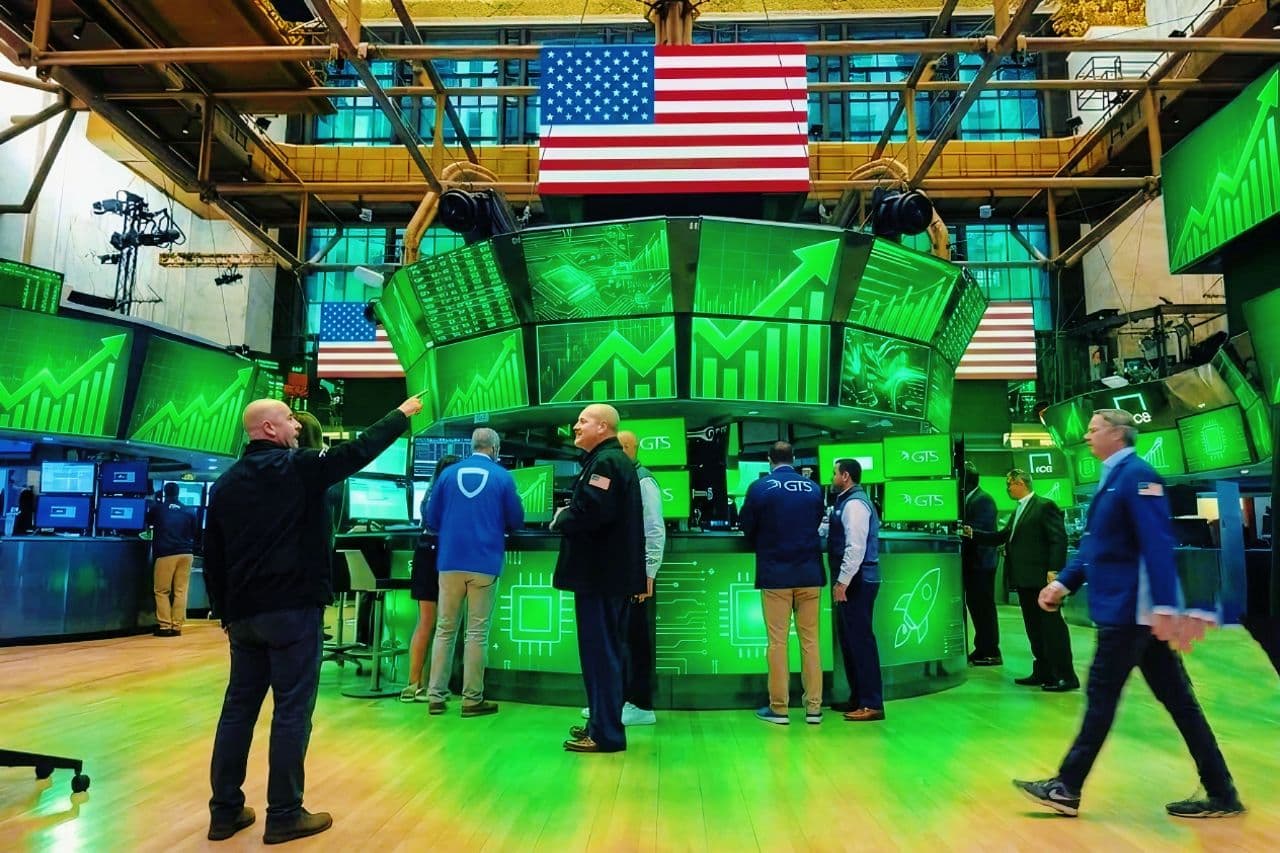
Dow Jones Rises as Nasdaq Slips on Data-Storage Stock Weakness
- Dow Jones rose 0.6%, supported by strength in energy and defense stocks.
- Nasdaq fell 0.4%, snapping a three‑session winning streak as data‑storage stocks like Sandisk, Western Digital, and Seagate dropped 5.5%–8%.
- S&P 500 ended flat, adding less than one point.
- Oil prices surged 4.5% to $58.50 a barrel, lifting energy names like APA (+8%), Halliburton (+6.2%), and Occidental (+5.5%).
- Defense stocks rallied after Trump called for a $1.5 trillion military budget, with Northrop Grumman, Lockheed Martin, and General Dynamics up 2%–4.5%.
- Alphabet hit an all‑time high, closing up 1.1% and nearing a $4 trillion market cap, surpassing Apple as the second most‑valuable company.
- Treasury yields edged higher to 4.19% as traders digested jobless claims, trade deficit, and productivity data.
- Gold rose 0.5% to $4,485 an ounce; Bitcoin held steady around $90,800; the U.S. dollar index gained 0.2% to 98.92.
Key Takeaways
Stock Market Update: Dow Jones Climbs, Nasdaq Slips on Tech Weakness
Major U.S. indexes closed mixed Thursday, with the Dow Jones Industrial Average up 0.6% while the Nasdaq fell 0.4%, breaking a three‑day winning streak. The S&P 500 finished flat, adding less than one point.
Energy stocks surged as West Texas Intermediate crude jumped 4.5% to $58.50 a barrel, lifting APA (+8%), Halliburton (+6.2%), and Occidental Petroleum (+5.5%). In contrast, data‑storage firms Sandisk, Western Digital, and Seagate dropped between 5.5% and 8%, dragging the Nasdaq lower.
Defense shares rebounded after President Trump called for a $1.5 trillion military budget, with Northrop Grumman, Lockheed Martin, and General Dynamics rising 2% 4.5%. Meanwhile, Alphabet gained 1.1% to a record high, surpassing Apple in market cap at roughly $3.9 trillion, while Apple slipped 0.5%.
Post‑earnings moves included Applied Digital soaring 8.1% and Constellation Brands climbing 5.6%. The 10‑year Treasury yield edged up to 4.19%, reflecting investor reaction to jobless claims, trade deficit, and productivity data.
Commodities and currencies showed modest moves: gold rose 0.5% to $4,485/oz, Bitcoin held near $90,800, and the U.S. dollar index gained 0.2% to 98.92.






The U.S. trade gap narrowed dramatically in October, falling to $29.4 billion, a nearly 40% drop from September and the lowest level since 2009. Economists had expected the deficit to widen, but instead imports fell more than 3% while exports rose 2.6%.
The improvement was driven almost entirely by a spike in gold and silver exports, which surged by more than $10 billion. That increase more than offset declines elsewhere and accounted for the total $7.1 billion rise in exports. The surge coincided with gold hitting a record high on October 20, reflecting investors’ rush into the safe‑haven asset.






Apple Card Moves to JPMorgan Chase: What It Means for Your Wallet
Apple (AAPL) and JPMorgan Chase (JPM) announced Wednesday that Chase will take over as the issuer of the Apple Card, replacing Goldman Sachs. The transition is expected to occur within two years, according to the companies.
For consumers, the shift will be seamless: credit-card balances, savings balances, payment history, credit limits, and Daily Cash rewards will all carry over to the new issuer. Daily Cash, Apple’s cash‑back feature, will continue to function as usual after transactions post.
One key change involves the Apple Savings account. Current and new Apple Card holders will still be able to open savings accounts, but existing customers will face a choice: move to a new JPMorgan‑issued Apple Savings account or keep their current Goldman Sachs account, according to reporting from The Wall Street Journal.






Colgate-Palmolive Stock Named Wall Street’s Top Consumer Pick for 2026
Morgan Stanley analysts have placed Colgate-Palmolive (CL) at the top of their Household & Personal Care sector list, citing expectations of a rebound in sales growth after a weaker 2025. They reaffirmed an “overweight” rating with an $87 price target, suggesting a 13% upside from the latest close and aligning with Visible Alpha’s Wall Street average.
The company, known globally for its toothpaste and personal care products, faced headwinds in 2025 as the broader consumer packaged goods sector struggled with “category weakness.” Strong results in 2024 also created tough comparisons, slowing market share gains in Colgate’s core categories.
After reporting just 0.4% organic sales growth in October, analysts believe Colgate has hit its low point and is now positioned to accelerate growth faster than competitors. They project 3% organic sales growth and 6% EPS growth in 2026, though they expect the company to remain cautious in its near-term outlook.
Looking ahead, Colgate-Palmolive is expected to benefit from easier comparisons, stronger performance in developing markets, and renewed momentum in its oral care segment, making it a standout stock entering 2026.






Alphabet Stock Nears $4 Trillion Market Cap: Can Momentum Continue?
Alphabet (GOOG)(GOOGL) shares climbed about 1% Thursday, pushing the company within reach of a $4 trillion valuation, a milestone only Nvidia, Apple, and Microsoft have ever crossed. Alphabet also overtook Apple this week to become America’s second most‑valuable company, its first time in that position since 2019.
The stock’s surge follows a 65% rally in 2025, making it the best‑performing member of the Magnificent Seven. Much of the excitement stems from the launch of Gemini 3, Alphabet’s newest AI model, which impressed investors and executives alike. Salesforce CEO Marc Benioff even declared he was “never going back” to ChatGPT, sparking competitive urgency at OpenAI.
Beyond the model’s capabilities, investors were drawn to the fact that Gemini 3 was trained on custom chips designed in‑house. Alphabet’s tensor processing units, developed with Broadcom, are now being positioned as a credible alternative to Nvidia’s GPUs, which dominate the AI hardware market.






Economic Calendar Update: Key U.S. Data Releases Delayed by Shutdown
| Date | Report(s) | Original Scheduled Release |
|---|---|---|
| Jan. 9 | September & October housing starts | Sept. report: Oct. 17 |
| Jan. 13 | New home sales (October, September) | Sept. report: Oct. 24 |
| Jan. 14 | October business inventories | December |
| Jan. 14 | November retail sales | December |
| Jan. 14 | November Producer Price Index (PPI) + subset of October report | Dec. 11 (Oct. report not released separately) |
| Jan. 15 | November U.S. import & export price indexes + subset of October report | Dec. 16 (Oct. report not released separately) |
| Jan. 22 | Q3 Gross Domestic Product, final update | Dec. 19 |
| Jan. 26 | November durable-goods orders | December |
| Jan. 30 | December Producer Price Index (PPI) | Jan. 14 |






Bloom Energy Stock Jumps on $2.65B Fuel Cell Deal
Bloom Energy (BE) shares surged 14% Thursday after American Electric Power (AEP) confirmed a $2.65 billion order for solid oxide fuel cells. The deal will support the development and construction of a new fuel cell generation facility, underscoring growing demand for clean energy solutions.
The San Jose‑based company has seen its stock climb nearly 400% over the past year, fueled by rising adoption of alternative energy technologies and large‑scale utility partnerships.






Costco Stock Climbs on Strong December Sales After Tough 2025
Costco Wholesale (COST) shares rose 5% Thursday, reversing part of their year‑long decline from early 2025 highs. The rally came after the company reported December sales up 8.5% year‑over‑year, with same‑store sales climbing 7%.
Food categories including bakery, meat, and candy drove growth, while jewelry, tires, and small appliances also performed well. The upbeat sales data lifted investor sentiment, pushing shares to levels last seen about a month ago.
Analysts at William Blair noted the results could provide a “much‑needed boost” after Costco stock fell nearly 10% over the past six months amid valuation concerns and sector rotation.






Senior Tax Deduction 2025: How Retirees Can Save More
A new tax break is available for Americans aged 65 and older, thanks to the ‘One Big Beautiful Bill’ passed in July 2025. The measure, also referred to as a Social Security tax break, applies retroactively to the entire 2025 tax year, meaning seniors can claim it when filing taxes in the coming months.
Under the new rule, individual taxpayers can deduct $6,000 from taxable income, while married couples who both qualify can deduct $12,000. This deduction is in addition to the standard deduction available to all non‑itemizers, as well as the existing extra standard deduction for older taxpayers, which allows singles to deduct $2,000 and married couples $1,600.






U.S. Economy Holds Steady as Manufacturing Falters Under Tariffs
The U.S. economy is showing resilience, but the divide between services and manufacturing is widening. The services sector expanded at its fastest pace in December, marking its 10th month of growth in the past year, according to the Institute for Supply Management. In contrast, manufacturing slowed for the 10th straight month, underscoring persistent weakness in the sector.
Surveys of supply managers highlight how manufacturers have struggled under tariffs that were intended to protect them. President Donald Trump’s sweeping import taxes, aimed at ushering in a “golden age” for industry, instead left companies facing higher costs, weaker demand, and policy uncertainty.
One chemical industry manager summed up the mood: “It has not been a great year…real consumer spending is down and tariffs are ultimately to blame. I hope for some return to free trade, which is what consumers have ‘voted for’ with their spending.”






Defense Stocks Surge as Trump Pushes $1.5 Trillion Military Budget
Shares of major defense contractors rallied Thursday after President Donald Trump called for a sharp increase in military spending. In a post on Truth Social, Trump said the 2027 defense budget should rise from $1 trillion to $1.5 trillion, citing the need to strengthen the country in “troubled and dangerous times.”
The announcement sent Lockheed Martin (LMT), Huntington Ingalls (HII), and L3 Harris (LHX) up more than 7%, leading gainers in the S&P 500. General Dynamics (GD) and Northrop Grumman (NOC) added over 4%, while RTX Corp. (RTX), parent of Raytheon, rose 2%.
The Department of Defense budget stood at $850 billion in fiscal 2025, up $34 billion from the prior year. The White House had already proposed a $113 billion increase for fiscal 2026, but Trump’s plan would represent a 50% jump in spending, signaling a major expansion in defense outlays.






Frontier Airlines Parent Boosts Profit Outlook, Names New CEO
Shares of Frontier Group Holdings (ULCC) climbed 4% Thursday morning after the ultra‑low‑cost carrier raised its fiscal 2025 fourth‑quarter profit forecast. The company now expects adjusted earnings per share to land at the higher end of its $0.04 $0.20 guidance range, citing stronger revenue momentum that offset the drag from the government shutdown.
Alongside the forecast update, Frontier confirmed that James Dempsey has been appointed President and CEO, officially removing his interim title. Dempsey, who stepped in on Dec. 15 after Barry Biffle’s 11‑year tenure, also joins the company’s board.
Despite Thursday’s rally, Frontier shares remain down more than 37% over the past year, reflecting investor caution even as management signals confidence in the airline’s recovery trajectory.






U.S. Job Market Update: Multiple Jobholders Hit Highest Level Since 1999
The Bureau of Labor Statistics reported that 5.8% of employed Americans held more than one job in November 2025, the highest rate of moonlighting since December 1999, when the figure reached 6%. This marks an increase from 5.4% over the prior 12‑month period, highlighting a growing reliance on multiple income streams even as overall hiring slows.
Forecasters expect the 5.8% rate to remain steady or possibly rise when December jobs data is released, underscoring the pressure workers face in balancing wages with rising costs. While the broader labor market shows signs of cooling, the surge in multiple jobholders reflects resilience and adaptation among U.S. workers.






Applied Digital Stock Surges on Blowout Q2 Results and AI Data Center Deals
Shares of Applied Digital (APLD) jumped more than 6% in premarket trading Thursday after the data center provider crushed expectations in its fiscal second quarter. Revenue soared 250% to $126.6 million, far above analyst estimates of $110.3 million, while the company posted a small adjusted profit of $0.1 million versus forecasts of a $13.3 million loss.
The company also announced it has signed two major data center leases with AI hyperscalers in North Dakota and is negotiating a third, underscoring its growing role in powering artificial intelligence infrastructure. Applied Digital’s stock has more than tripled in value over the past year, reflecting investor enthusiasm for its rapid expansion and AI‑driven growth strategy.






Vanda Pharmaceuticals Stock Drops After FDA Rejects Jet Lag Treatment Application
Shares of Vanda Pharmaceuticals (VNDA) fell more than 12% in premarket trading Thursday after the company disclosed that the FDA’s Center for Drug Evaluation and Research (CDER) did not approve its supplemental New Drug Application (sNDA) for HETLIOZ (tasimelteon) as a treatment for jet lag disorder.
The FDA acknowledged positive efficacy in Vanda’s clinical trials but concluded the data did not provide sufficient evidence of effectiveness. Regulators argued that the company’s controlled phase‑advance protocols shifting bedtimes by five to eight hours were not fully representative of actual jet travel, which involves factors such as reduced oxygen pressure, physical constraints, noise, and lighting changes.
Vanda said it “respectfully disagrees” with the FDA’s interpretation and remains committed to working with regulators to advance approval of HETLIOZ for jet lag disorder. Despite Thursday’s decline, Vanda shares had gained more than 80% over the past year entering the session.






Energy Stocks Rally on Venezuela Oil Shake-Up
The U.S. government’s plan to overhaul Venezuela’s oil industry after ousting the country’s president is sparking gains in select energy stocks. Energy Secretary Chris Wright announced Wednesday that the U.S. will control Venezuelan oil sales “indefinitely”, funneling proceeds through American banks while rolling back sanctions that have restricted crude exports for years.
Refiners Valero Energy (VLO) and Phillips 66 (PSX) rose on the news, reflecting investor optimism about increased access to Venezuelan crude. Meanwhile, Chevron (CVX) the only U.S. oil major still operating in Venezuela could see outsized benefits. Its established presence gives it a head start that may be worth billions if the Trump administration follows through on rebuilding the country’s energy sector.
Despite Venezuela holding the largest proven oil reserves globally, years of corruption, sanctions, and economic turmoil have crippled its production capacity. A revitalization effort could unlock significant opportunities for U.S. refiners and producers positioned to capitalize on renewed exports.






Intel’s Turnaround: Signs of Momentum in 2026
Intel (INTC) shares have surged more than 15% in 2026, reflecting renewed investor confidence in its chip manufacturing revival. The company’s unveiling of “Panther Lake” AI PC chips, built on its long‑awaited 18A process, marks a milestone in Intel’s effort to prove it can scale cutting‑edge semiconductor technology.
The turnaround story has been dramatic. After years of costly missteps under former CEO Pat Gelsinger, Intel’s foundry business was in crisis entering 2025. New CEO Lip‑Bu Tan quickly cut costs and sold assets to stabilize operations. The real inflection point came in August 2025, when Tan secured a nearly $10 billion investment from the U.S. government, making Washington Intel’s largest shareholder. Soon after, Nvidia (NVDA) invested $5 billion and agreed to collaborate, signaling industry validation of Intel’s strategy.
With government backing, strategic partnerships, and its first successful product launch on the new node, Intel is beginning to look like a credible competitor to TSMC again. While shares were little changed in premarket trading Thursday, the broader trajectory suggests that the turnaround gamble may finally be paying off.






Trump Targets Housing Market With Investor Ban Proposal
President Donald Trump unveiled the first details of his plan for sweeping housing reforms, announcing he will push to ban large institutional investors from purchasing single‑family homes. In a social media post, Trump wrote: “People live in homes, not corporations,” emphasizing affordability concerns for ordinary buyers.
The proposal is expected to be the first in a series of housing reforms promised during his Dec. 17 national address. More specifics are anticipated at Trump’s upcoming speech at the World Economic Forum in Davos (Jan. 19 23).
The backdrop is a housing market that has sidelined many would‑be buyers. Mortgage rates stayed above 6% throughout 2025, while home prices remained elevated. Analysts note that investor activity has further strained affordability, making it harder for individuals and families to compete for homes.

Mortgage Affordability Rules
| Rule / Guideline | How It Works | Purpose |
|---|---|---|
| 28% Rule | Max mortgage payment = 28% of monthly gross income | Prevents housing costs from overwhelming budget |
| 36% Rule | Total debt (mortgage + other loans) ≤ 36% of monthly gross income | Ensures overall debt remains manageable |
| Income Multiple | Mortgage should be ≤ 2–3× annual gross income | Quick affordability check |
Key Takeaway
The 28/36 rule remains the gold standard for determining affordability, but in today’s market, many households especially younger buyers are stretching beyond these limits. Elevated rates and prices mean that even “median” mortgages may not fit comfortably within traditional guidelines.
The Bottom Line
- Stocks & Markets: Major indexes are mixed, but sector‑specific stories are driving sharp moves—defense stocks rallying on Trump’s military budget push, energy names reacting to Venezuela’s upheaval, and tech giants like Alphabet nearing historic valuations.
- Corporate Earnings & Deals: Applied Digital crushed expectations with AI‑driven data center growth, Bloom Energy soared on a $2.65B fuel cell order, while Vanda Pharmaceuticals sank after an FDA rejection. Frontier Airlines lifted its profit forecast and named a permanent CEO.
- Housing & Policy: Trump is targeting institutional investors in housing reform, while affordability remains strained with mortgage rates above 6%. New tax deductions for seniors and delayed government economic reports are shaping the fiscal landscape.
- Macro Trends: Services are expanding strongly, but manufacturing continues to struggle under tariffs. More Americans are working multiple jobs than at any time since 1999, highlighting household pressures despite overall economic resilience.
- Investor Takeaway: The market is being driven by policy shocks, sector‑specific catalysts, and AI innovation. Defensive positioning, energy exposure, and tech momentum are key themes, while housing affordability and labor market strain remain risks to watch.