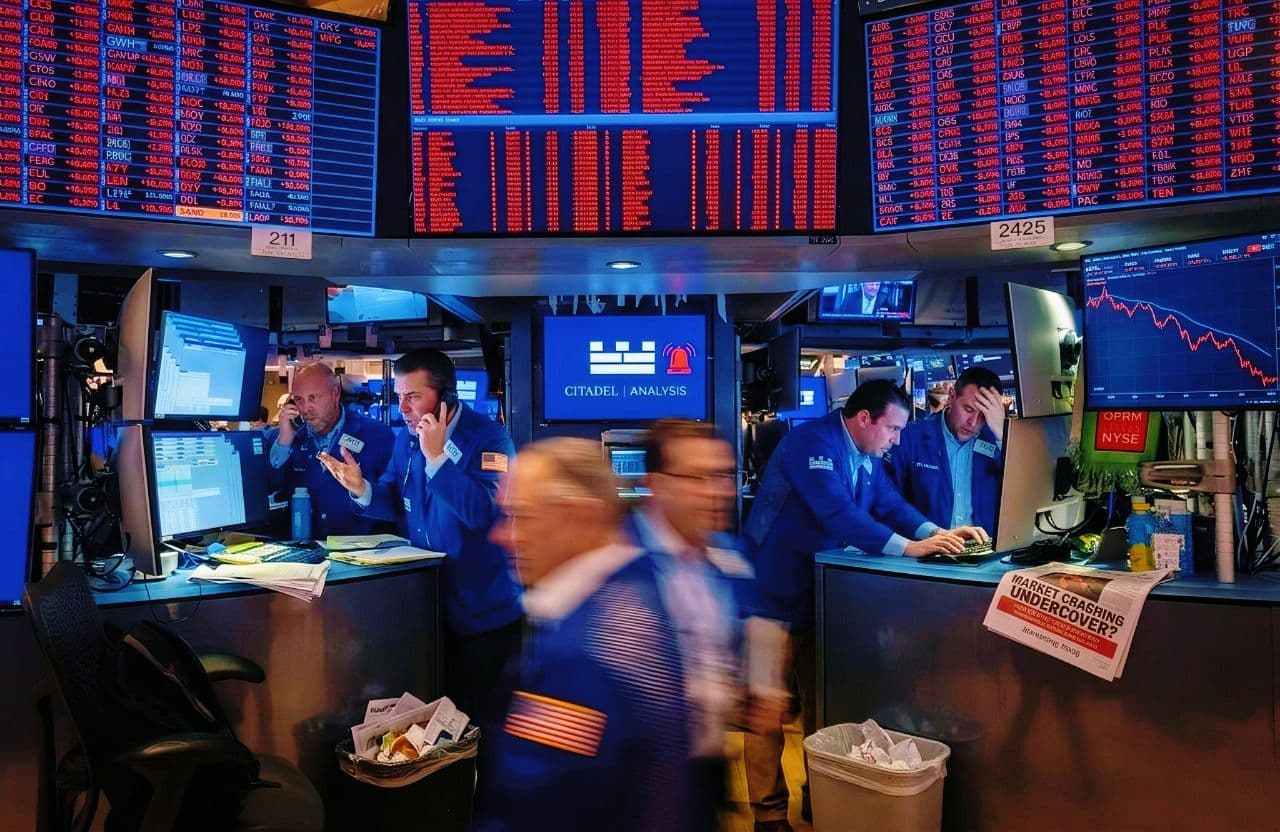
Dow Jones Update: Stock Futures Fall, Gold Hits Record as DOJ Probes Fed Chair Powell
- Stock Futures Drop: Dow Jones, S&P 500, and Nasdaq futures fell 0.7%, 0.6%, and 0.8% respectively after news of a DOJ probe into Fed Chair Jerome Powell.
- Gold Hits Record High: Gold surged past $4,600 an ounce, reaching a new all-time high as investors sought safe-haven assets.
- Dollar & Bonds: The U.S. dollar index slipped 0.3% to 98.80, while the 10-year Treasury yield rose to 4.20%.
- Crypto & Commodities: Bitcoin traded around $90,700, slightly higher, while crude oil (WTI) dipped nearly 1% to $58.55 a barrel.
- Credit Card Stocks Sink: Shares of Synchrony (-9%), Capital One (-8%), Citigroup (-4%), and American Express (-4%) fell after President Trump called for a one-year cap on credit card interest rates at 10%.
- Exxon Mobil Pressure: Exxon shares slipped after Trump said he’d likely keep the company out of Venezuela, citing “uninvestible” conditions.
- Airline Shake-Up: Sun Country Airlines soared 13% after Allegiant announced a $1.5B acquisition deal, while Allegiant’s stock dropped 3%.
Key Takeaways
Dow Jones Futures Fall, Gold Prices Hit Record, DOJ Investigation of Fed Chair Powell
Stock futures fell sharply Monday while gold surged to a new all-time high after the Justice Department launched a criminal probe into Federal Reserve Chair Jerome Powell.
Powell said in a video statement that the DOJ served grand jury subpoenas tied to his Senate Banking Committee testimony last June regarding Fed office renovations. He wrote that criminal charges were a consequence of setting interest rates based on public interest rather than presidential preferences.
Nasdaq 100, Dow Jones Industrial Average, and S&P 500 futures dropped 0.8%, 0.7%, and 0.6% respectively. This came after major indexes closed at record highs Friday, fueled by a stronger-than-expected decline in the U.S. unemployment rate.
Gold futures crossed $4,600 an ounce for the first time, rising 2.6% to $4,620. The U.S. dollar index slipped 0.3% to 98.80, while the 10-year Treasury yield climbed to 4.20%. Bitcoin traded near $90,700, and WTI crude oil fell nearly 1% to $58.55 a barrel.
Credit card stocks sank after President Trump called for a one-year cap on interest rates at 10%. Synchrony and Capital One dropped more than 9% and 8%, Citigroup and American Express fell about 4%, while JPMorgan, Bank of America, and Wells Fargo slipped around 2%.
Exxon Mobil shares edged lower after Trump said he would likely keep the company out of Venezuela, citing “uninvestible” conditions.
Sun Country Airlines jumped 13% after Allegiant announced a $1.5 billion acquisition deal, including $400 million in debt, while Allegiant shares fell 3%.






Could President Donald Trump’s second year in office defy the historical pattern of weak stock performance? Data suggests challenges ahead, but history alone doesn’t tell the full story.
The second year of a presidential term is often the weakest in the four-year cycle, according to the “Presidential Election Cycle Theory” developed by Yale Hirsch of the Stock Trader’s Almanac. The theory argues that U.S. stocks typically underperform in the first year after an election, with the second year proving even softer, before momentum builds in the latter half of the term.
Analysts point to early policy reactions and political uncertainty ahead of midterms as reasons for weaker performance in the first half of a term. Conversely, efforts to stimulate the economy and strengthen influence before the next election often help returns in the second half.
Bank of America analysts recently cautioned that historical data supports expectations of underperformance in 2026, before a likely rebound in 2027. Since 1940, the S&P 500 has averaged just 4.2% gains in second years of presidential terms, compared to 9% annually overall. Still, a potential “Santa Claus rally” in late 2026 could lift markets to close out the year.






Sun Country Airlines Stock Jumps as Allegiant Announces $1.5B Leisure Airline Merger
Investors cheered Sun Country Airlines Holdings (SNCY) after shares surged 13% in premarket trading Monday, following news that Allegiant Travel Company (ALGT) will acquire the budget carrier to form a leading leisure-focused U.S. airline.
The $1.5 billion deal, which includes $400 million in net debt, sent Allegiant stock down 3% before the bell. The merger is expected to close in the second half of 2026, with Allegiant and Sun Country shareholders owning 67% and 33% of the combined company. Operations will remain separate until a single FAA certificate is obtained.
Leadership of the new company will be headed by Allegiant CEO Gregory Anderson, while Sun Country CEO Jude Bricker will join the board as an advisor. The headquarters will be in Las Vegas, but the airline will maintain a strong presence in Minneapolis-St. Paul.
The companies said the merger will create one of the most resilient airline models in the industry, capable of adapting to shifting market conditions, traveler demand, and cargo needs. They emphasized benefits for customers, employees, and communities through expanded opportunities and continued investment.
Regulatory hurdles are expected to be minimal, as Allegiant primarily serves small-city routes with limited competition, while Sun Country focuses on Amazon cargo flights, charter services, and scheduled routes across the U.S. and international destinations in Mexico, Canada, Central America, and the Caribbean.






The Bottom Line
Stock futures dropped sharply as the DOJ opened a criminal probe into Fed Chair Jerome Powell, shaking investor confidence. Gold surged past $4,600 an ounce to a new record high, underscoring safe-haven demand amid market volatility. The dollar weakened, Treasury yields rose, and crude oil slipped, while Bitcoin held steady. Credit card stocks fell after President Trump called for a cap on interest rates, Exxon edged lower on Venezuela concerns, and airline stocks diverged as Sun Country soared on Allegiant’s $1.5B acquisition deal.