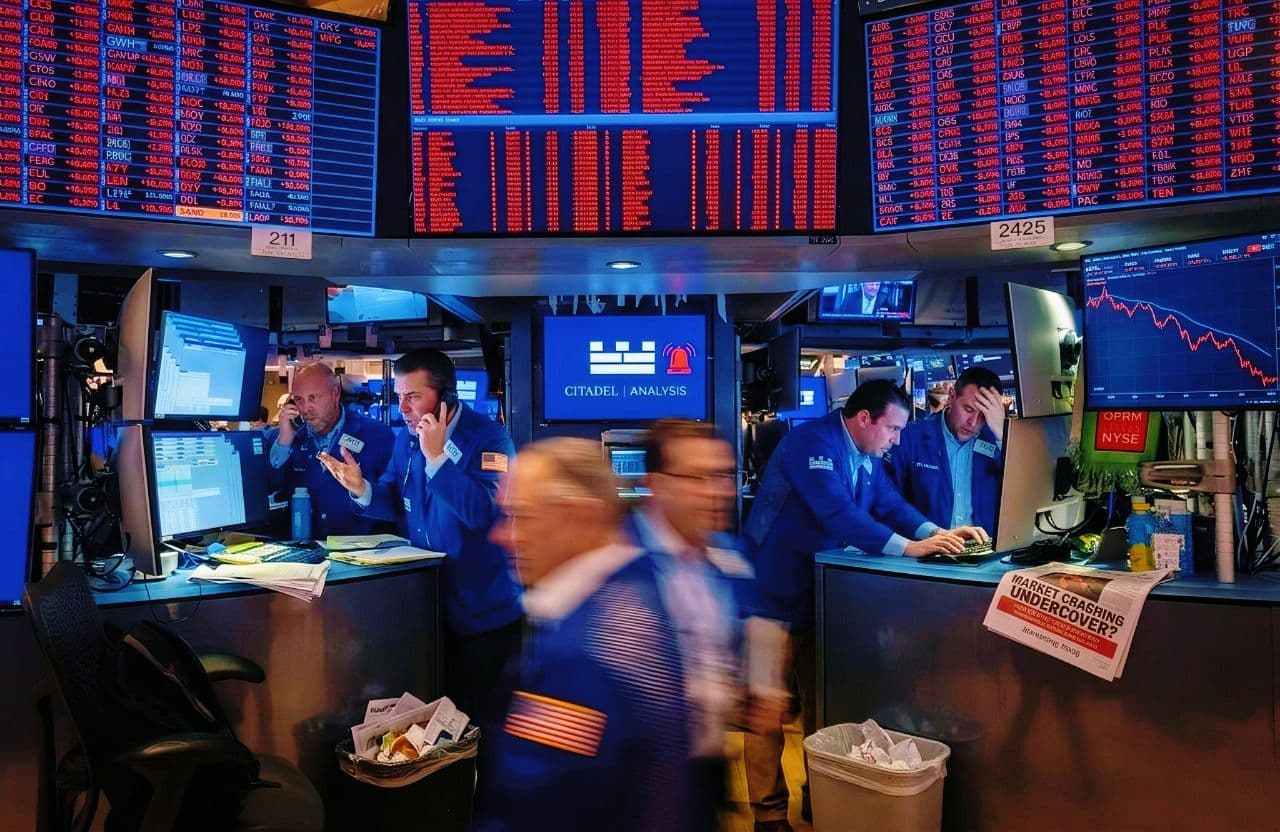
Dow Tops 50K, Bitcoin Jumps Above $70K as Markets Rebound
- Dow milestone: The Dow Jones Industrial Average closed above 50,000 for the first time, rallying more than 1,200 points after a three-day sell-off.
- Indexes rebound: S&P 500 gained 2% and Nasdaq rose 2.2%, though both remain on multi-week losing streaks.
- Nvidia (+8%) and Caterpillar (+7%) led Dow gainers.
- Amazon (-5.5%) was the biggest Dow decliner after weak earnings.
- Stellantis (-25%) plunged on a $26B restructuring charge.
- Crypto comeback: Bitcoin rebounded from lows near $60K to above $70,700, lifting crypto-linked stocks like MicroStrategy (+25%), Marathon Digital (+22%), and Coinbase (+13%).
- Commodities: Gold rose nearly 2% to $4,975, silver edged up to $77, and crude oil ticked higher to $63.40 per barrel.
- Treasury yields: The 10-year yield climbed to 4.21%, signaling tighter borrowing conditions.
- Sector trends: Tech stocks drove the rally, while communications and consumer discretionary sectors lagged.
Key Takeaways
Dow Breaks 50K, Bitcoin Recovers Above $70K as Markets Rally
Major U.S. stock indexes staged a sharp rebound Friday, with the Dow Jones Industrial Average closing above 50,000 for the first time after a three-day sell-off. The Dow surged more than 1,200 points to 50,137, while the S&P 500 gained 2% and the Nasdaq rose 2.2%. Nvidia and Caterpillar led Dow gainers, while Amazon dropped over 5% on weak earnings. Stellantis plunged 25% after announcing a $26 billion restructuring charge, and post-earnings moves saw Roblox jump nearly 10% while Molina Healthcare sank 26%.
Bitcoin rebounded above $70,700 after briefly dipping near $60,000, lifting crypto-linked stocks like MicroStrategy (+25%), Marathon Digital (+22%), and Coinbase (+13%). Commodities also rallied, with gold up nearly 2% to $4,975 and silver edging higher to $77. The 10-year Treasury yield rose to 4.21%, signaling tighter borrowing conditions, while crude oil ticked up to $63.40 a barrel and the U.S. dollar index slipped slightly to 97.63.


AI, once the unstoppable growth engine for Big Tech, is now sparking investor anxiety. The four hyperscalers Meta, Microsoft, Alphabet, and Amazon outlined aggressive infrastructure spending plans in recent earnings reports, with Meta and Alphabet doubling last year’s budgets. Amazon shocked markets with a forecast of $200 billion in 2026 capital expenditures, 50% higher year-over-year and well above Wall Street expectations. Microsoft’s spending is also surging, rising more than 60% last quarter.
The result has been a sharp sell-off in tech stocks, as traders worry about overspending and disruption across the software industry. Yet some analysts argue this pullback is a “fantastic sign,” suggesting markets are finally distinguishing between hype and sustainable growth. For investors, the debate underscores both the risks of runaway AI investment and the potential for a healthier, more disciplined tech sector.


Fed Officials Split on Economy Outlook: Stabilizing or Precarious?
Federal Reserve officials offered contrasting views Friday on the state of the economy. Fed Governor Philip Jefferson expressed cautious optimism, noting that the unemployment rate at 4.4% has “changed little” in recent months, suggesting stabilization after a slowdown. He emphasized that employers have avoided mass layoffs, pointing to resilience in the labor market.
By contrast, San Francisco Fed President Mary Daly highlighted that working households feel conditions are precarious. Surveys show consumers expect unemployment to rise and jobs to become scarcer over the next six months. Job openings have already fallen to their lowest level since the pandemic, reinforcing skepticism among workers about the economy’s trajectory.


Chip Stocks Rally as Nvidia CEO Highlights Explosive AI Demand
America’s largest cloud providers are pouring billions into AI hardware, and while their shares have stumbled, chipmakers are surging. Nvidia stock jumped nearly 8% Friday, helping push the Dow above 50,000 points for the first time. Amazon shares slumped after unveiling a massive AI spending forecast, but semiconductor peers AMD, Broadcom, and Marvell all rallied, sending the PHLX Semiconductor Index up nearly 6%.
Nvidia CEO Jensen Huang told CNBC that demand is “going through the roof,” describing the current wave of AI adoption as an inflection point. He predicted cloud giants are leading what could become the largest infrastructure buildout in history, fueling optimism across the chip sector even as investors weigh the risks of overspending in Big Tech.


S&P 500 and Nasdaq End Week Lower Despite Dow Rally Past 50K
The S&P 500 surged 2% Friday but still closed lower for the third time in four weeks, reflecting lingering weakness after a three-day sell-off. The Nasdaq also finished down 1.8% for the week, marking its fourth straight weekly decline. Despite the rally, both indexes remain under pressure, highlighting investor caution around tech-heavy sectors.
By contrast, the Dow Jones Industrial Average snapped a three-week skid, ending 2.5% higher for the week after a 1,200-point surge Friday that pushed it past the 50,000 milestone for the first time. Year-to-date, the Dow is up about 4% and the S&P 500 has gained 1%, while the Nasdaq is down 2%, underscoring the uneven performance across major indexes.


Communications and Consumer Discretionary Stocks Lag as Tech Leads Market Rally
On Friday, while the S&P 500 surged 1.8% late in the trading session, the Communication Services and Consumer Discretionary sectors underperformed, falling 1.8% and 1.4% respectively. In contrast, Information Technology stocks advanced 4%, leading gains across the other nine sectors.
News Corp dropped 6% to pace declines in Communication Services, while Amazon fell 7% to lead losses in Consumer Discretionary. The divergence highlights how sector performance remains uneven, even on strong market rally days, with tech continuing to dominate momentum.


Crypto Market Suffers Sharp Weekly Losses as Bitcoin and Altcoins Slide
This week’s crypto downturn rattled investors, with Bitcoin plunging near $60,000 in one of its steepest single-day declines in a decade before rebounding to around $71,000 Friday. Despite the recovery, weekly losses remain in double digits. Altcoins such as ether and solana dropped about 25%, underscoring the breadth of the sell-off. Hyperliquid’s native token was a rare bright spot, gaining 11% amid widespread declines.
Digital asset treasury firms also took heavy hits, with Strategy, Bitmine Immersion Technologies, and Twenty One Capital all posting double-digit losses over the past five sessions. The rout highlights growing anxieties about the resilience of digital assets and their ripple effects across crypto-linked stocks.


Jennifer Garner’s Once Upon a Farm Launches $200M IPO on NYSE
Jennifer Garner’s co-founded children’s food company, Once Upon a Farm, debuted on the New York Stock Exchange Friday under the ticker OFRM. The firm raised nearly $200 million in its initial public offering, selling close to 11 million shares at $18 each right in the middle of the marketed range. Garner rang the NYSE opening bell to mark the milestone.
The IPO price gives the baby food brand, known for its cold-pressure food pouches, a market capitalization of about $724 million. The listing highlights growing investor interest in health-focused consumer brands, especially those tied to celebrity-backed ventures.


Amazon Stock Drops 8% as $200B AI Spending Plan Alarms Investors
Amazon shares sank 8% Friday, making it the weakest performer in the Dow Jones Industrial Average, even as broader markets rallied. The decline comes after the company revealed plans to spend up to $200 billion this year on capital expenditures, far exceeding Wall Street expectations. Executives said most of the spending will target cloud infrastructure, including data centers and equipment, to expand AI capacity.
The announcement has rattled investors, with concerns that such aggressive spending could weigh on profitability. Amazon stock is now down about 12% year-to-date, underscoring the tension between long-term AI ambitions and near-term market skepticism.


Dow Jones Rallies as Nearly All Components Trade Higher
The Dow Jones Industrial Average surged 750 points Friday morning, with 27 of its 30 components in positive territory. Salesforce slipped just 0.2%, while Amazon fell 8% and Verizon declined 1.5%, making them the only laggards. Nvidia led the rally with a 6% gain, followed by Caterpillar and 3M, which rose 5% and 4% respectively.
The broad strength across Dow components underscores investor confidence during a milestone week, as the index crossed the 50,000 threshold for the first time. Tech and industrial names drove momentum, offsetting weakness in Amazon and Verizon, and highlighting the resilience of blue-chip stocks in a volatile market environment.


.jpg&w=828&q=75)
Stellantis Stock Plunges 25% as EV Strategy Reset Triggers $26B Charge
Stellantis shares tumbled 25% Friday morning, hitting their lowest level since April 2020, after the automaker announced a sweeping business reset. The company, which owns Jeep, Chrysler, and Dodge, said it will take a charge of about 22 billion euros ($26 billion) in the second half of 2025 as part of an overhaul of its electric vehicle strategy. The move mirrors recent pivots by Ford and General Motors, which also scaled back all-electric ambitions in favor of hybrids and traditional combustion models.
CEO Antonio Filosa acknowledged that Stellantis had misjudged the pace of the energy transition, distancing itself from consumer demand. He added that the charges reflect both overestimation of EV adoption and poor operational execution, which he pledged to fix since taking over in mid-2025. The announcement underscores the challenges automakers face balancing innovation with profitability in a shifting global market.
Fed Study Suggests Rising Incomes, Not Housing Shortages, Driving Home Prices
A new analysis from the Federal Reserve Bank of San Francisco challenges the widely held belief that housing shortages are the main driver of soaring home prices. Researchers found that housing supply has grown faster than population in many U.S. cities, including expensive markets like San Francisco. Instead, the study points to rising incomes as the key factor pushing home prices higher, with wealthier buyers bidding properties out of reach for others.
Led by Schulyer Louie of UC Irvine, the research highlights how affordability challenges may stem less from underbuilding and more from income-driven demand. With rent and ownership costs climbing relative to typical wages, policymakers face pressure to rethink solutions. The findings suggest that addressing income inequality could be just as critical as boosting housing supply in tackling the affordability crisis.
Novo Nordisk and Eli Lilly Stocks Rebound as FDA Targets Copycat Drugs
Shares of Novo Nordisk and Eli Lilly bounced back Friday after sinking 8% the day before. The recovery came after FDA Commissioner Dr. Marty Makary announced on social media that the agency will take swift action against companies mass-marketing illegal copycat drugs. Novo Nordisk stock jumped 7.5% and Eli Lilly rose 3.5% in pre-market trading, reversing some of their losses.
The rebound followed news that Hims & Hers Health planned to sell a lower-priced compounded weight-loss pill, which had initially sent its shares up 14% before sliding. On Friday, Hims & Hers stock dropped another 7%. The company’s pill, priced at $49 per month, uses the same active ingredient as Novo Nordisk’s FDA-approved Wegovy, which costs $149 for self-pay patients. The FDA emphasized that it cannot verify the safety or effectiveness of non-approved drugs, reinforcing investor confidence in established pharmaceutical leaders.
Newell Brands Stock Falls 12% on Weak Q1 Guidance Despite Solid Q4 Results
Newell Brands, parent of Rubbermaid and Sharpie, reported fiscal 2025 fourth-quarter earnings that met analyst expectations but disappointed investors with its outlook. The company posted adjusted EPS of $0.18 on revenue of $1.90 billion, slightly above consensus estimates. However, shares dropped 12% pre-market Friday after Newell projected a normalized Q1 loss per share of $0.08 to $0.12, wider than analysts’ expected $0.03 loss. The firm also forecast a 3% to 5% sales decline, compared to consensus expectations of a 1.6% drop.
Management attributed the weak guidance to shipment timing rather than underlying consumer demand. Still, the stock has already lost more than half its value over the past year, and the latest forecast underscores ongoing challenges in stabilizing performance. Investors remain cautious as the company navigates declining sales and margin pressures in 2026.
Vanguard Says Bonds Offer Real Yields as Stocks Look Overvalued
Vanguard CIO Gregory Davis told CNBC that investors may want to tilt portfolios toward bonds, noting the 10-year Treasury yield at 4.2% offers a real return for the first time in nearly a decade. Bond yields have climbed since the Fed’s aggressive rate hikes in 2022, while stocks have surged driven by AI investment with the S&P 500 up about 90% since October 2022.
Davis cautioned that U.S. equities “have been overvalued for some time,” and Vanguard expects stock and bond returns to be “pretty comparable” over the next decade. The firm’s 2026 market preview projects mid-single-digit stock returns, echoing similar forecasts from Goldman Sachs.
The Bottom Line
- The Dow Jones Industrial Average closed above 50,000 for the first time ever, powered by a 1,200-point rally Friday.
- The S&P 500 and Nasdaq still ended the week lower, despite strong gains on the final trading day.
- Bitcoin bounced back above $70,000 after plunging earlier in the week, though crypto markets remain volatile.
- Sector performance was mixed: tech stocks led gains, while communications and consumer discretionary lagged.
In short, equities staged a dramatic rebound to close the week, with the Dow hitting a historic milestone, but broader market sentiment remains cautious, especially in tech and crypto.