Market Rises as Supreme Court Overturns Tariffs, GDP Data Weak
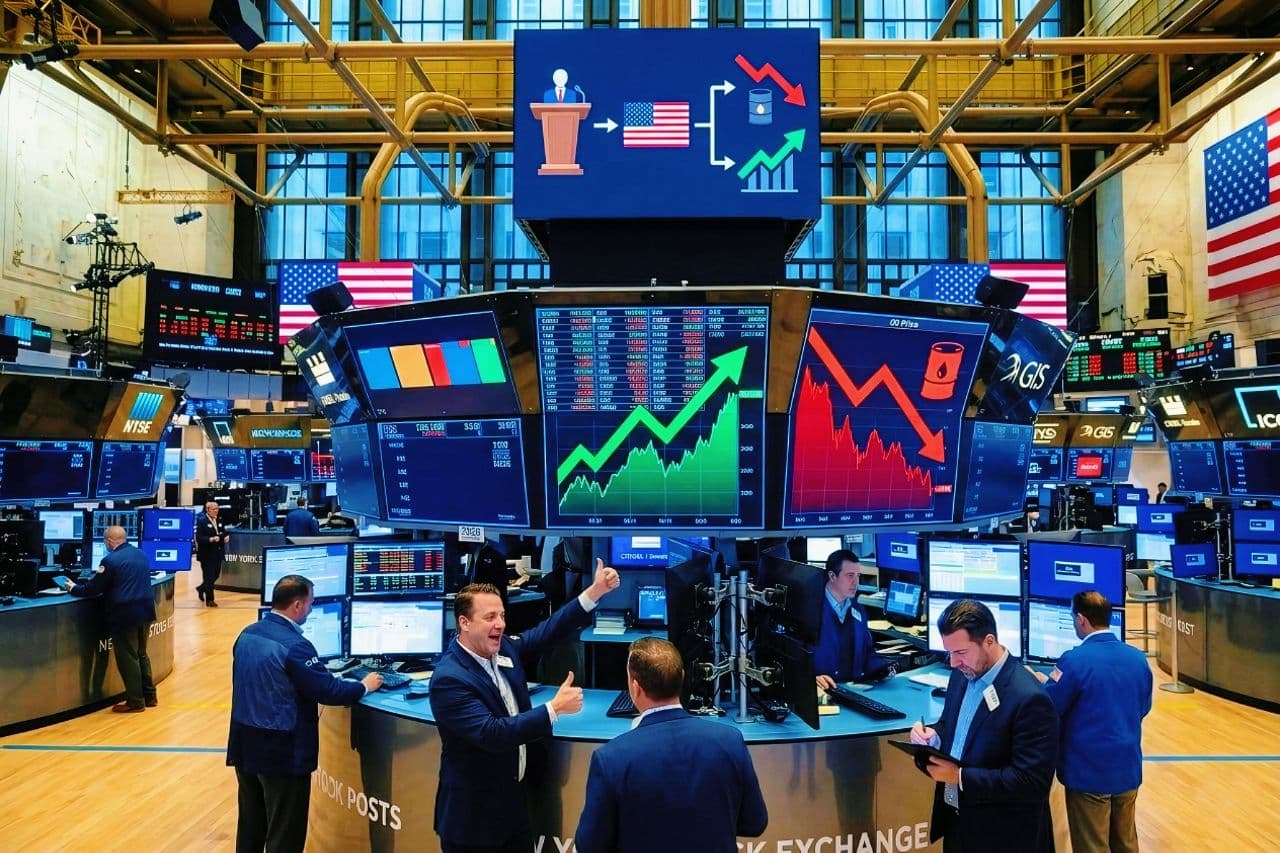
- The Supreme Court’s decision to strike down most of Trump’s tariffs sent stocks higher, signaling investor optimism about reduced trade tensions and potential relief from inflationary pressures. Major indexes rose as markets welcomed the possibility of lower import costs and improved corporate margins.
- At the same time, fresh GDP data disappointed, showing weaker-than-expected growth. This tempered enthusiasm and highlighted ongoing concerns about the strength of the U.S. economy. Analysts noted that while the tariff ruling could ease costs for businesses and consumers, sluggish growth remains a challenge for markets.
- The combination of legal, political, and economic developments underscores the volatility investors face. Relief from tariffs may provide short-term gains, but the broader outlook will depend on whether new trade measures are introduced and how quickly the economy regains momentum.
Key Takeaways
Stocks Climb After Supreme Court Strikes Down Trump Tariffs, Despite Weak GDP
The major indexes rose Friday after the Supreme Court struck down Trump’s sweeping tariffs, a major setback for his signature economic policy. The Nasdaq gained 0.7%, the S&P 500 advanced 0.6%, and the Dow added 0.4%, signaling investor optimism about reduced trade tensions.
The ruling came alongside disappointing economic data. Inflation ran hotter than expected, with the PCE price index up 2.9% year-over-year, while GDP growth slowed sharply to 1.4% in Q4, down from 4.4% in Q3. Analysts noted that while the tariff decision could ease costs for businesses and consumers, weak growth remains a concern.
Markets also reacted to sector-specific news: Applovin rose on reports of a new social media platform, while Grail and Akamai plunged on disappointing results. Big tech stocks mostly rallied, with Alphabet up 4% and Amazon up 2%.
Commodity markets were mixed oil held steady, gold surged 2% as geopolitical tensions rose, and silver jumped 8%. Bitcoin slipped below $68,000, while the dollar index edged lower.


Prediction market contracts are gaining traction, and now ETF issuers want in. Roundhill Investments, Bitwise Asset Management, and GraniteShares have all filed with the SEC to launch funds tied to event contracts derivatives that track binary outcomes such as election results.
If approved, these ETFs would allow investors to bet on outcomes like the 2028 presidential election or upcoming congressional races, institutionalizing prediction markets much like ETFs did for cryptocurrency. Bitwise CIO Matt Hougan described ETFs as a potential “crowning achievement” in the prediction market journey.
The SEC’s decision remains uncertain, and the timeline for review is unclear. But if greenlit, these funds could open prediction markets to everyday investors while also attracting professional money managers.






Applovin Stock Jumps on Plans to Launch Social Media Platform
Shares of Applovin (APP) rose 4% Friday after reports surfaced that the ad tech company is developing its own social media platform. A senior executive discussed the initiative on a Chinese-language podcast, and Bloomberg reported the company has already posted a job listing to lead the project.
Applovin previously bid to acquire TikTok’s U.S. operations but lost out to a joint venture including Oracle, Silver Lake, and MGX. Now, the company appears to be pursuing its own path into social media.
According to Bloomberg, Applovin’s chief product officer described the effort as the opposite of Meta’s approach. While Facebook built a massive audience before monetizing, Applovin already has advanced ad tools it just needs its own audience.
The company’s stock has soared in recent years thanks to its AI-powered ad placement platform, rising more than 1,700% between early 2024 and late 2025. However, shares have faced pressure recently from short seller reports and broader concerns about AI disruption across tech and finance.






Fed’s Key Inflation Gauge Ends 2025 Hotter Than Expected
The Federal Reserve’s preferred inflation measure, the Personal Consumption Expenditures (PCE) index, rose 2.9% year-over-year in December, higher than economists’ forecasts of 2.8%. Core PCE, which excludes food and energy, climbed 3% its highest annual increase since February and well above the Fed’s 2% target.
The uptick is especially concerning for policymakers, as it signals inflationary pressures remain persistent despite earlier signs of cooling. Analysts point to Trump’s sweeping tariffs announced in April 2025 as a key driver, with merchants passing costs on to consumers. While housing costs have stabilized, tariffs have kept overall prices elevated.
Heather Long, chief economist at Navy Federal Credit Union, warned the report will “trigger more concern inside the Fed that inflation needs a closer look again.”
The release, delayed by last year’s government shutdown, came alongside weak GDP data showing just 1.4% growth in Q4 far below expectations and sharply down from 4.4% in Q3.






Netflix Stock Outlook Strong Even Without Warner Bros. Deal
Analysts at Wedbush reiterated their bullish stance on Netflix (NFLX), saying the streaming giant will be fine even if its planned merger with Warner Bros. Discovery (WBD) doesn’t go through. They maintained a $115 price target nearly 50% above current levels arguing Netflix’s business is “entirely healthy” with strong global advertising growth.
The deal faces uncertainty as Warner Bros. reopened talks with Paramount Skydance, raising the possibility of competing bids and regulatory hurdles. Still, Wedbush emphasized Netflix doesn’t need the acquisition to thrive, citing 18% year-over-year revenue growth in Q4 and widening operating margins.
Netflix expects 15% sales growth in the current quarter, reinforcing confidence in its standalone strategy. Shares of Netflix rose more than 1% Friday, while Warner Bros. edged higher and Paramount slipped about 1%.






Corning Stock Hits Record High on AI Data Center Boom
Shares of Corning (GLW) surged 7% Friday, topping $140 for the first time ever, as demand for its fiber-optic cables from AI-driven data centers continues to soar. The stock is up nearly 60% year-to-date, riding enthusiasm around artificial intelligence infrastructure spending.
Corning recently announced a $6 billion deal with Meta to supply cables for its expanding data center network. Hyperscalers including Alphabet, Microsoft, Amazon, and Oracle are expected to spend more than $600 billion on infrastructure this year, much of it directed toward AI-enabling equipment.
The rally marks a milestone for Corning, whose shares have finally surpassed their dot-com era peak set in 2000 during the internet infrastructure boom. After collapsing to under $2 in 2002, the stock has rebounded dramatically, now fueled by AI’s transformative demand.






Tariff-Exposed Stocks Rally After Supreme Court Ruling
Shares in industries heavily impacted by Trump’s tariffs surged Friday after the Supreme Court struck down his signature economic policy. Footwear makers Deckers Outdoor, Birkenstock, and Crocs each gained more than 2%, while furniture companies Wayfair and Floor & Decor jumped over 4%. Williams Sonoma rose nearly 2%.
International marketplaces also rallied: Amazon climbed 2.5%, eBay 3.5%, and Etsy soared 7%. These sectors had been hit hardest by tariffs due to reliance on overseas manufacturing and imports.
However, many stocks pared gains later in the session as uncertainty set in. Trump vowed to reimpose tariffs under different legal authorities, leaving investors cautious about how long the relief will last.






Supreme Court Overturns Trump’s Tariffs, Trade Policy in Limbo
The Supreme Court struck down most of President Trump’s 2025 tariffs, ruling in a 6-3 decision that he exceeded his authority under the International Emergency Economic Powers Act. About 75% of the tariffs were invalidated, including sweeping “reciprocal” import taxes on goods from major trading partners.
Tariffs on automobiles and steel remain in place under Section 232 of the Trade Expansion Act, but the ruling throws U.S. trade policy into uncertainty. Trump has vowed to reimpose tariffs under different legal authorities, raising questions about how quickly new measures will be introduced and at what levels.
The decision marks a major setback for Trump’s signature economic policy and opens the door to potential lawsuits over refunds, while businesses and consumers await clarity on future trade costs.






Palantir Stock Slide Seen as Buying Opportunity, Analysts Say
Palantir (PLTR) shares have dropped 36% from November highs amid a broader pullback in software stocks and valuation concerns. Despite the slump, analysts at Mizuho upgraded the stock to “outperform” this week, setting a $195 price target 44% above recent levels.
They argue the pullback is overdone, pointing to strong AI demand trends and Palantir’s expanding commercial business. In their words, Palantir is “in a category of one,” delivering revenue growth, acceleration, and margin expansion at scale unlike any other software company.
While only half of analysts tracked by Visible Alpha currently rate the stock a “buy,” the Street’s average target of $207 suggests a potential rebound to November highs.






U.S. GDP Growth Slows Sharply to 1.4% in Q4, Below Expectations
The U.S. economy grew at an annualized rate of just 1.4% in the fourth quarter, down from 4.4% in Q3 and well below economists’ forecasts of 2.4%. The slowdown highlights the impact of the 43-day government shutdown in October and November, which Deutsche Bank researchers estimate shaved 70 basis points off growth.
President Trump blamed the weaker GDP on Democrats, writing on social media that the shutdown “cost the U.S.A. at least two points in GDP.” Friday’s figures are an advance estimate and will be revised twice before final numbers are released in April.
The disappointing data adds to concerns about the economy’s momentum heading into 2026, with inflation pressures still elevated and trade policy uncertainty following the Supreme Court’s tariff ruling.






The Bottom Line
Markets rallied after the Supreme Court struck down most of Trump’s tariffs, but the broader economic picture remains mixed.
- Stocks: Major indexes rose, with tariff-exposed sectors like footwear, furniture, and e-commerce leading gains. Big tech also climbed, signaling investor optimism about reduced trade tensions.
- Economy: GDP growth slowed sharply to 1.4% in Q4, far below expectations, while inflation ran hotter than forecast. The combination of weak growth and persistent price pressures complicates the outlook.
- Policy: The ruling invalidates tariffs imposed under emergency powers but leaves others intact. Trump has vowed to reimpose tariffs under different authorities, keeping trade uncertainty alive.
- Investor sentiment: Relief from tariffs boosted equities short term, but questions about future trade policy and sluggish economic data temper enthusiasm.
In short: The Court’s decision lifted stocks, but weak GDP and sticky inflation highlight ongoing challenges. Trade policy remains unsettled, leaving investors bracing for volatility.