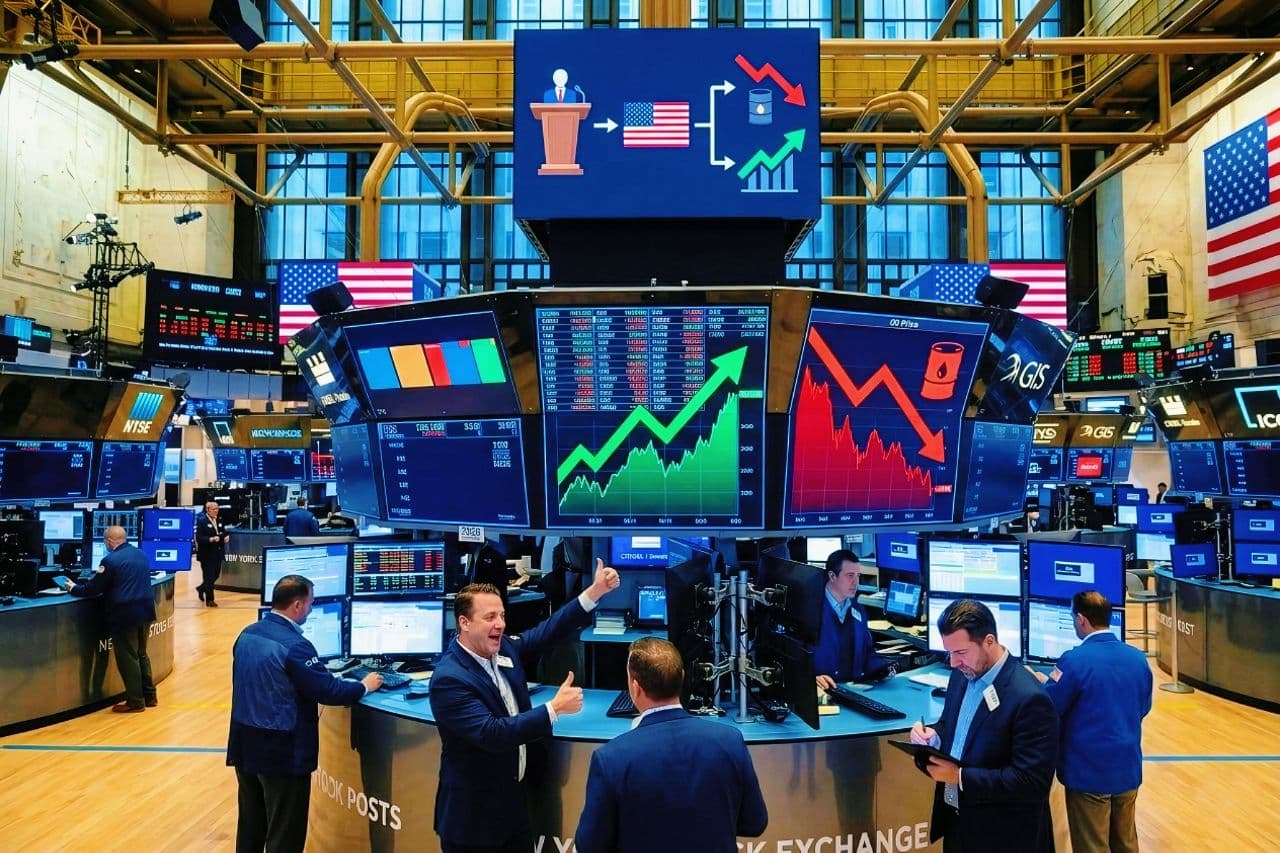
Oil Stocks Jump, Dow Breaks Records Following Venezuela Shock
- Indexes Rally: The Dow Jones Industrial Average surged nearly 600 points, setting all‑time intraday and closing records. The Nasdaq snapped a five‑session losing streak, while the S&P 500 also closed higher.
- Maduro’s Capture: The U.S. military’s seizure of Venezuelan President Nicolás Maduro over the weekend fueled optimism about a revival of Venezuela’s oil industry, boosting energy stocks.
- Oil Stocks Soar: Shares of Chevron (+5%), Valero (+9%), SLB (+9%), Halliburton (+8%), Phillips 66 (+7%), and Marathon Petroleum (+6%) led gains across the sector.
- Tech Pullback: AMD (-1.1%) and Nvidia (-0.4%) gave up early gains ahead of their CES 2026 appearances in Las Vegas.
- Safe‑Haven Assets: Gold (+3%) and silver (+7%) jumped, while the 10‑year Treasury yield slipped to 4.16%.
- Crypto Strength: Bitcoin traded above $94,100, rebounding from weekend lows near $89,300.
- Currency Moves: The U.S. dollar index edged down 0.1% to 98.28.
Key Takeaways
Markets News, Jan. 5, 2026: Dow Hits Record High as Oil Stocks Surge After Maduro’s Capture
Major U.S. stock indexes closed sharply higher Monday, with the Dow Jones Industrial Average setting fresh intraday and closing records after the U.S. military seized Venezuelan president Nicolás Maduro over the weekend.
The Dow gained nearly 600 points, up 1.2%, while the Nasdaq rose 0.7% and snapped a five‑session losing streak. The S&P 500 added 0.6%, marking a strong start to the first full trading week of 2026.
U.S. armed forces captured Maduro early Saturday, following his indictment on drug‑trafficking charges. He pleaded not guilty in federal court in New York today. President Donald Trump declared Sunday night that the U.S. was “in charge” of Venezuela, a nation with the world’s largest oil reserves.
Oil prices rallied, with West Texas Intermediate futures up 1.9% to $58.40 per barrel. Chevron (CVX), the only U.S. oil company active in Venezuela, advanced 5% to pace the Dow. Other energy names surged: Valero Energy (VLO) +9%, SLB +9%, Halliburton (HAL) +8%, Phillips 66 (PSX) +7%, and Marathon Petroleum (MPC) +6%.
Tech stocks lagged, with AMD (‑1.1%) and Nvidia (‑0.4%) slipping after early gains. Both CEOs Jensen Huang (Nvidia) and Lisa Su (AMD) are set to speak at CES 2026 in Las Vegas later today.
Safe‑haven assets climbed, with gold futures up 3% to $4,450 an ounce and silver up 7% to $75.90 an ounce. The 10‑year Treasury yield fell to 4.16% from 4.19%.
Bitcoin traded above $94,100, rebounding from weekend lows near $89,300, while the U.S. dollar index slipped 0.1% to 98.28.






Versant (VSNT) shares dropped sharply in their first day of trading on the Nasdaq Monday, following the company’s official spin‑off from Comcast (CMCSA).
The stock opened just above $45 but closed at $40.57, after dipping near $39 during the session.
Comcast first announced the spin‑off in late 2024, separating its cable TV assets including CNBC, MSNBC (rebranded as MS NOW), USA Network, Golf Channel, and more. The new entity, which also owns digital brands Fandango and Rotten Tomatoes, was later named Versant.
For investors, Versant offers fresh exposure to the cable TV sector an industry with limited new entrants. Its early trading performance may serve as a barometer of investor sentiment toward the shrinking cable TV business.






Bitcoin Price Rally: U.S. Capture of Venezuela’s Maduro Sparks Investor Debate
Bitcoin (BTCUSD) has broken out of its recent slump following the surprise weekend capture of Venezuelan president Nicolás Maduro by U.S. forces.
The world’s largest cryptocurrency, which lagged the broader stock market last year, is showing renewed strength trading above $94,000 as of Monday afternoon, levels not seen in weeks. Crypto‑linked equities also rallied, with Coinbase Global (COIN) and MicroStrategy (MSTR) each gaining more than 4%. Oil stocks climbed as well, fueled by hopes that U.S. energy companies could benefit from a revival of Venezuela’s oil industry.
Analysts at Bitunix noted that “escalating pressure without direct military conflict” supports Bitcoin’s appeal as a decentralized hedge asset, reinforcing its role during geopolitical uncertainty rather than signaling a broad return to risk‑on appetite.
Dean Chen, a Bitunix analyst, added that ousting Maduro is “not a direct bullish catalyst” for Bitcoin, but may serve as an indirect one by highlighting crypto’s utility in regions facing sanctions and capital restrictions.






401(k) After Death: What Beneficiaries Need to Know
A 401(k) is often one of the largest assets a person owns, but its handling after death follows rules different from other estate property. Unlike assets distributed through a will, a 401(k) bypasses the estate process entirely.
Instead, the account transfers directly to the named beneficiary. This means that whoever is listed on the account receives the funds, regardless of what the will specifies. If beneficiaries haven’t been updated, the money could end up in unintended hands.
Financial experts stress that understanding this process is critical. As Daniel Milks, founder of Woodmark Advisors, explains, the most important fact is that a 401(k) does not automatically become part of the estate it follows the beneficiary designation on file.






AI Stocks in Spotlight: Nvidia’s Huang and AMD’s Su Headline CES 2026
Investors are turning their attention to Las Vegas this week as Nvidia (NVDA) and Advanced Micro Devices (AMD) executives prepare to take the stage at the CES consumer electronics trade show.
Nvidia CEO Jensen Huang is scheduled for a press conference at 4 p.m. EST, while AMD CEO Lisa Su will deliver a keynote at 9:30 p.m. EST. Su is expected to outline her vision for AI solutions spanning cloud, enterprise, edge, and devices, while Huang will showcase Nvidia’s latest innovations driving productivity across industries, according to the CES agenda.
The event comes at a critical time for AI companies. In late 2025, investors questioned when firms would begin to see returns on the hundreds of billions invested in data centers and AI model development. Those concerns pressured stocks, raising doubts about whether the AI boom fueling the broader market is sustainable.






Homebuyers in 2025: Saving for a Down Payment Takes Seven Years
For most Americans, saving for a home down payment remains a long process, though buyers are reaching the goal faster than in recent years.
In 2025, the typical buyer needed seven years to save for a median down payment, according to Realtor.com down sharply from 12 years in 2022. Still, the timeline is nearly double what it was before the pandemic, when surging home prices pushed ownership further out of reach.
The report found two main reasons for the challenge: higher home prices continue to raise the cost of down payments, while a lower savings rate makes it harder for buyers to accumulate funds.






Zenas BioPharma Shares Crash Despite Phase 3 Trial Success
Zenas BioPharma (ZBIO) reported what it called “positive” late‑stage clinical trial results Monday, but investors reacted harshly.
Shares of the Waltham, Mass.-based biotech plunged 55%, even though its treatment for Immunoglobulin G4‑Related Disease (IgG4‑RD), obexelimab, achieved its primary endpoint in a Phase 3 study.
The company said obexelimab delivered a 56% reduction in flare risk compared to placebo, a result it described as both statistically significant and clinically meaningful.
However, Zenas disclosed it is not currently eligible for milestone payments under its agreement with Royalty Pharma Investments. Talks are ongoing, but the company cautioned there is no assurance of future payments under the Royalty Purchase Agreement.
Despite Monday’s nosedive, Zenas BioPharma shares remain up nearly 60% over the past year, underscoring the volatility of biotech investing.






Novo Nordisk Shares Climb as Wegovy Weight-Loss Pill Launches in U.S.
Novo Nordisk (NVO) stock rose 4% Monday after the debut of its newly approved Wegovy pill in the U.S.
The Danish drugmaker said the GLP‑1 treatment, cleared by the FDA less than two weeks ago, could “open new possibilities” for more than 100 million Americans living with obesity.
The pill’s entry dose of 1.5 mg costs $149 per month (about $5 per day) for self‑pay patients. Higher doses of 4 mg, 9 mg, and 25 mg will also be available, with the 4 mg dose priced at $149 monthly until April 15, then rising to $199, while the top dose will cost $299.
“This launch is about redefining what’s possible in weight management,” said Ed Cinca, Novo Nordisk’s senior vice president of Marketing & Patient Solutions, adding that the company worked to make the Wegovy pill affordable and accessible for patients.






Should You Buy a Home in 2026? Housing Trends to Watch
Home sales stayed near historic lows in 2025 as high prices and elevated mortgage rates kept many buyers sidelined. Still, affordability is expected to improve slightly in 2026, offering a potential opening for house hunters waiting for the right time.
That shift could create opportunities for buyers who have been holding back. Several housing trends will shape the market in 2026, making timing and strategy critical for those considering a purchase.
Mortgage rates, which peaked above 7% in early 2025, eased to about 6.2% by year‑end, giving buyers some relief from steep borrowing costs.
Most analysts don’t expect rates to drop much further. The Mortgage Bankers Association forecasts rates between 6% and 6.5% in 2026, while Redfin projects an average of 6.3%. The National Association of Realtors also expects rates to hover “around 6%.”






Big Bank Savings Secrets: Why Your Money Earns So Little
Banks pay interest on savings accounts to attract deposits, which they then use to issue loans and generate profits. But the annual percentage yield (APY) offered by major banks is shockingly low, leaving most customers unaware of just how little they’re earning.
The nation’s largest institutions Chase, Bank of America, and Wells Fargo pay just 0.01% APY on standard savings accounts. On a $10,000 balance, that translates to only $1 of interest in an entire year.
By contrast, moving the same amount into a high‑yield savings account could generate more than $400 annually, and opening one often takes only minutes online.






AI Disrupts Entry-Level Jobs, But Graduate Careers Show Strong Growth
Recent graduates with bachelor’s degrees are finding it harder to secure jobs, as tariffs and the expanding role of AI slow hiring across industries. Many students are choosing graduate school instead of entering a “low‑hire, low‑fire” labor market.
While AI is reshaping entry‑level opportunities, certain graduate programs are opening doors to stronger career prospects. According to the Bureau of Labor Statistics, demand for substance abuse, behavioral disorder, and mental health counselors is set to rise significantly in the coming years. Lawyers and career counselors are also projected to enjoy abundant opportunities, making these fields attractive paths for graduates seeking stability and growth.
2025 Housing Affordability Crisis in Charts: What Shifted and What Stayed the Same
Homebuyers hoping for relief in 2025 found little change, as high housing costs continued to weigh on affordability nationwide.
Experts project modest improvements in 2026, though any easing is expected to be gradual. Some buyers may see better conditions, while others will still face challenges entering the market.
According to a report from Compass, affordability is beginning to improve slowly not through sharp price drops, but via a mix of flat home prices, rising incomes, and gradually declining mortgage rates.
When Saving Outperforms Paying Down Student Loans—and When It Doesn’t
Got a holiday bonus? Deciding whether to stash it in a high‑yield savings account or CD versus using it to pay down student loans comes down to one factor: the interest rate.
If your savings option offers a higher yield than your loan’s interest rate, saving wins. But if your loan rate is higher, paying it down delivers the better financial outcome.
For undergraduate loans taken between mid‑2006 and 2025, rates typically range from 2.75% to 6.8%, while graduate and parent loans often carry steeper rates. Loans issued before 2006 may have variable interest, making the decision more nuanced.
Childcare Costs Outpace Inflation, Driving More Women Out of Workforce
With childcare prices climbing faster than rent and college tuition, more mothers are leaving jobs to become full‑time caregivers.
Daycare costs rose 5.2% in September 2025 compared to a year earlier, nearly double the 3% annual inflation rate, according to Bank of America and the Bureau of Labor Statistics.
For the first time since 2021, more women reported that family responsibilities were the reason they were not in the labor force.
Childcare expenses have surged so high that the cost for one child now exceeds a month’s rent for some families, according to the Department of Labor. A 2024 report from The Conference Board also found average childcare costs surpassing annual tuition at a four‑year public college by nearly $1,800.
Oil Stocks Surge as U.S. Capture of Venezuela’s Maduro Fuels Energy Rally
Investors reacted swiftly to the weekend news that Venezuelan President Nicolás Maduro is no longer in power, with energy stocks climbing sharply in Monday’s premarket session.
The U.S. military strike that led to Maduro’s capture he faces drug‑trafficking charges in Manhattan federal court sparked optimism that Venezuela’s vast oil reserves could soon be rebuilt under U.S. oversight. President Donald Trump said the U.S. would “run” Venezuela until an orderly transition is possible, with American oil companies expected to play a central role.
Energy shares surged in response. Chevron (CVX), the only U.S. oil company currently active in Venezuela, jumped 6%. Rivals ConocoPhillips (COP) and Exxon Mobil (XOM) gained 6% and 3%, respectively. Oilfield‑services firms also rallied, with Halliburton (HAL) and SLB each up 8%, and Baker Hughes (BKR) rising 6.5%.
Refiners joined the rally: Valero Energy (VLO) +7%, Marathon Petroleum (MPC) +5%, and Phillips 66 (PSX) +5%. Meanwhile, West Texas Intermediate crude futures edged 0.7% higher to $57.75 per barrel.
QXO Stock Jumps on $1.2B Apollo-Led Investment
QXO (QXO) shares surged 7% in premarket trading Monday after announcing a $1.2 billion convertible preferred equity investment from an Apollo Global Management led group. The roofing and waterproofing company said the capital will help fund acquisitions as it pursues aggressive growth.
QXO has set ambitious targets: $50 billion in annual revenues within the next decade, driven by accretive acquisitions and organic expansion. The firm aims to become the tech-enabled leader in the $800 billion building products distribution industry.
Brad Jacobs, a serial entrepreneur who has taken six companies public, stepped down from his chairman roles at XPO (XPO) and GXO Logistics (GXO) on Dec. 31 to focus on Jacobs Private Equity and QXO, where he serves as CEO and chairman.
Despite Monday’s pop, QXO shares are already up nearly 25% over the past year, underscoring investor confidence in Jacobs’ track record and Apollo’s backing.
The Bottom Line
Markets are riding a wave of geopolitical shock after the U.S. military captured Venezuelan president Nicolás Maduro. The Dow hit all‑time records, energy stocks surged, and oil futures climbed as investors bet on U.S. firms rebuilding Venezuela’s oil industry. Safe‑haven assets like gold and silver spiked, while Bitcoin rebounded above $94,000.
Geopolitical upheaval is reshaping asset flows oil and energy stocks are the clear winners, tech is mixed, and investors are hedging with crypto and precious metals.