Stock Market Outlook: Dow Hits Record, S&P & Nasdaq Slip
- Major indexes mixed: The Dow Jones Industrial Average rose 0.1%, closing at an all-time high for the third straight session, while the S&P 500 fell 0.3% and the Nasdaq dropped 0.6%.
- Retail sales surprise: December U.S. retail sales came in flat, missing expectations of a 0.4% rise, pressuring consumer sentiment.
- Treasury yields eased: The 10-year Treasury yield fell to below 4.15%, down from 4.21%, reflecting softer economic data.
- Earnings movers: Spotify surged 15%, Datadog jumped 14%, Hasbro gained 7.5%, while Upwork sank 19%. Financial stocks like S&P Global and Raymond James fell sharply on AI-related concerns.
- Commodities & crypto: Bitcoin traded around $68,800, gold slipped 0.4%, silver fell 1.7%, and crude oil edged down to just above $64 a barrel.
Key Takeaways
Stock Market Update: Dow Hits Record, S&P & Nasdaq Fall
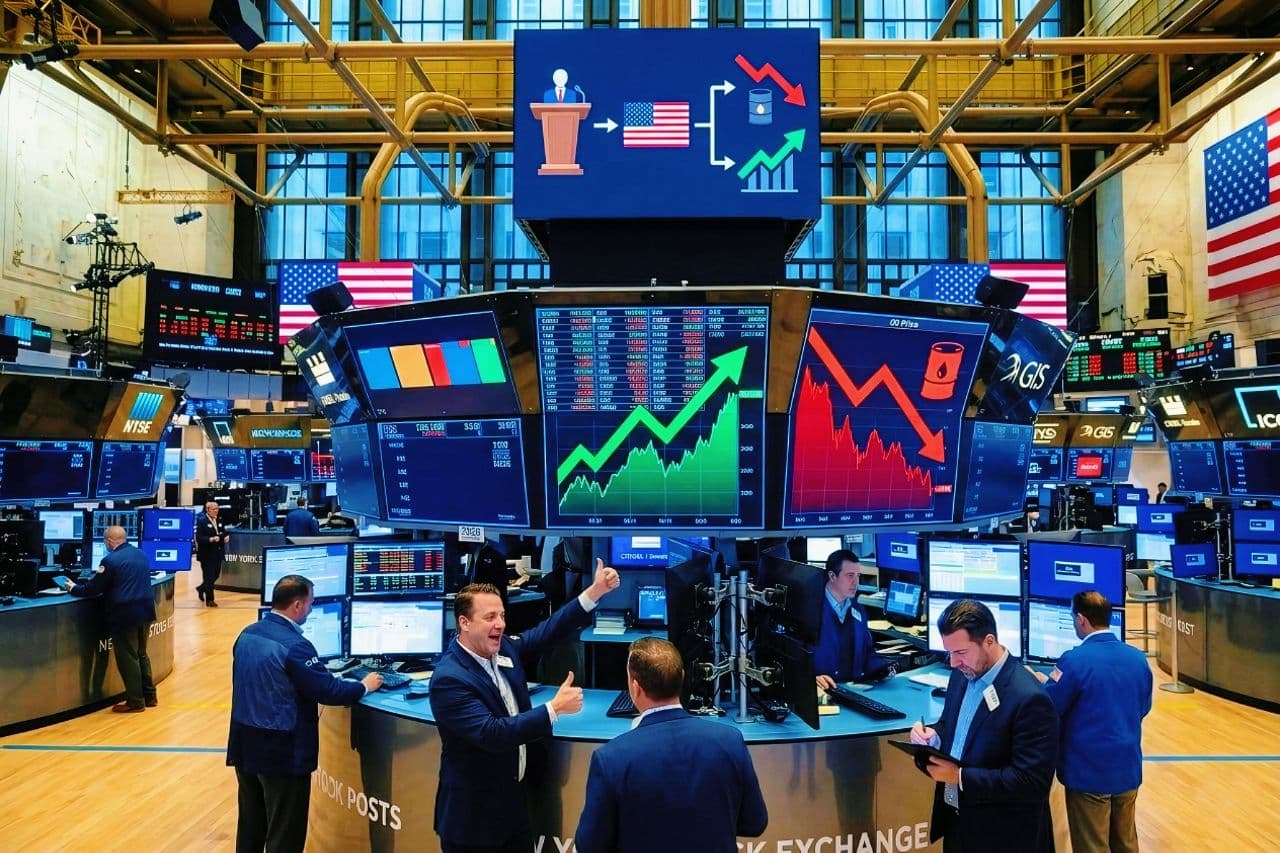
Major U.S. indexes closed mostly lower Tuesday as financial stocks slumped on AI-related concerns, though the Dow Jones Industrial Average managed a fresh all-time high for the third straight session. The Nasdaq dropped 0.6% and the S&P 500 slipped 0.3%, while the Dow edged up 0.1%, extending its record streak.
Treasury yields fell after December retail sales data came in flat, missing expectations of a 0.4% rise. The 10-year yield dropped below 4.15%, down from 4.21%, signaling softer economic momentum. Post-earnings moves drove volatility: Spotify surged 15%, Datadog jumped 14%, and Hasbro gained 7.5%, while Upwork sank 19%. Financial firms like S&P Global and Raymond James tumbled nearly 10% and 9%, respectively, as AI worries weighed on wealth-management stocks.
Commodities and crypto also weakened. Bitcoin traded near $68,800, down from overnight highs above $70,000. Gold slipped 0.4%, silver fell 1.7%, and crude oil edged lower to just above $64 a barrel






OpenAI Momentum Boosts AI Stocks
Fresh optimism around OpenAI’s financial outlook is lifting sentiment across the AI sector. While OpenAI itself isn’t publicly traded, its recent moves like rolling out ads in ChatGPT and unveiling updates to its Codex tool have reassured investors about its ability to monetize and compete. CEO Sam Altman also told employees that ChatGPT is back to exceeding 10% monthly growth, with a new model expected soon.
This string of positive developments has helped ease concerns about competition and obligations, shifting the narrative back in OpenAI’s favor. As a result, shares of tech heavyweights tied to OpenAI’s ecosystem have seen renewed enthusiasm, even after rival Anthropic’s tools recently rattled software stocks. The company’s momentum is proving influential not just for AI adoption but also for broader market sentiment.






Trump’s Fed Pick: Warsh Faces 15% Growth Challenge
President Trump has set an extraordinary expectation for his new Federal Reserve chair nominee, Kevin Warsh, calling for an economic growth rate of 15% a level rarely seen outside of wartime. In an interview with FOX Business, Trump argued that sharp interest rate cuts could deliver such growth, though he did not specify the exact metric or timeframe.
Warsh, a former Fed governor, would inherit a high bar. Economic growth is typically measured as inflation-adjusted annual GDP, which historically averages 2% 3% per year. Achieving Trump’s target would require unprecedented conditions, raising questions about feasibility. Economists note that such growth has only occurred during extraordinary rebounds or crises, making Trump’s goal more aspirational than realistic.






UBS Downgrades Tech: AI Spending Peak Looms
Software stocks have rebounded after last week’s sell-off, but UBS warns the optimism may be misplaced. On Tuesday, the firm’s chief investment office downgraded the U.S. technology sector to neutral, citing uncertainty in the software industry and expectations that AI infrastructure spending will soon moderate.
UBS notes that spending on AI infrastructure has surged more than fourfold in the past three years, with Big Tech firms like Microsoft, Alphabet, Amazon, Meta, and Oracle projected to report capital expenditures of up to $700 billion this year. While moderating capex growth could ease investor concerns about overspending, it poses risks for companies in the enabling layer such as Nvidia, Broadcom, and Micron whose earnings have swelled amid the data center boom.






Financial Stocks Drag S&P 500 Lower
Financial shares led the decline in the S&P 500 Tuesday afternoon, pulling the benchmark slightly lower. The Financials Sector dropped 1%, making it the weakest performer among the 11 tracked industries. Major names including S&P Global, Charles Schwab, and Raymond James Financial posted steep losses of 8.4%, 8.2%, and 7.9%, respectively.
With about 90 minutes left in the trading day, six sectors were in the red. On the upside, Utilities outperformed with a 2.2% gain






Datadog Stock Surges on Strong Q4 Results, Bullish Outlook
Datadog shares jumped 15% Tuesday, leading the S&P 500 gainers after the company reported stronger-than-expected fourth-quarter results. The New York-based AI-powered observability and security platform posted $953 million in revenue, up 29% year-over-year, and adjusted operating income of $230 million, both beating analyst expectations.
For the current quarter, Datadog projects revenue between $951 million and $961 million and adjusted operating income of $195 million to $205 million, slightly above consensus estimates. CEO Olivier Pomel highlighted plans to expand AI-powered innovation in observability, security, and analytics, reinforcing confidence in the company’s growth trajectory. Despite today’s sharp rally, Datadog shares remain down more than 10% over the past year, underscoring the volatility in tech stocks.






Michael Saylor’s Strategy Keeps Buying Bitcoin
Strategy (MSTR) continues to double down on its Bitcoin bet despite recent price pressure. Executive Chairman Michael Saylor told CNBC Tuesday that the company is “not going to be selling” and will keep buying Bitcoin every quarter “forever.” The cryptocurrency is trading below $70,000 after last week’s sell-off that briefly pushed it near $60,000, leaving Strategy’s holdings under water compared to its average purchase price.
Crypto-linked stocks were mixed in Tuesday trading. Coinbase and Strategy slipped slightly, while Circle gained more than 2%. Saylor’s vow to hold signals the company’s willingness to ride out volatility rather than lock in losses. Analysts say the next test will be whether buyers return at higher levels, as the mid-$70,000s failed to attract the demand some experts anticipated.






AI-Powered Tax Tools: Convenience vs. Risk
Artificial intelligence has transformed tax preparation from simple rule-based software into end-to-end AI-powered platforms. Today’s tools allow users to upload forms, interact conversationally, and complete filings seamlessly. This shift promises efficiency and clarity, with AI capable of explaining jargon and flagging potential issues before submission.
Yet, handing over your tax return means entrusting sensitive financial data to algorithms. A tax return represents your entire financial life, filed under your name as a legal document. While AI can streamline the process, the risks of data exposure and reliance on automated judgment remain critical considerations for anyone weighing whether to adopt these tools.






Spotify Stock Soars on Record User Growth, Strong Q4 Earnings
Spotify delivered its best-ever quarter of user growth, sending shares up more than 18% in Tuesday trading. The streaming giant reported 4.53 billion euros ($5.39 billion) in revenue, narrowly beating estimates, while earnings per share of 4.43 euros crushed analyst expectations. The company added 38 million net new monthly active users, reaching 751 million MAUs and 290 million premium subscribers, both ahead of forecasts. Co-CEO Alex Norström called it the largest quarterly rise in Spotify’s history.
Looking ahead, Spotify expects 4.5 billion euros in Q1 revenue, along with 759 million MAUs and 293 million premium subscribers. Analysts had projected slightly higher revenue but fewer users, suggesting Spotify’s growth momentum remains strong. The company is also set to benefit from premium subscription price hikes announced last month. Despite the surge, shares remain down about 15% year-to-date and nearly 40% off their highs from last June, underscoring ongoing volatility in the stock.






Student Loan Forgiveness Continues Despite 2025 Pause
Despite major changes to repayment programs under President Trump’s administration, roughly 121,000 borrowers still received student loan forgiveness in 2025. Forgiveness was paused for income-based repayment plans, while the Public Service Loan Forgiveness (PSLF) program was reworked, and the broader repayment system overhauled. Even so, the Department of Education forgave loans for more than 117,000 public service workers, far exceeding historical averages.
While the scale was smaller than the sweeping forgiveness seen under Trump’s predecessor, the numbers highlight that relief continued even amid policy uncertainty. The PSLF program, which cancels debt after 10 years of qualifying payments, remained the primary driver of forgiveness, underscoring its role as a lifeline for public service employees navigating shifting repayment rules.






Trump Accounts Offer Tax-Free Wealth Twist
The Trump Accounts, created under the One Big Beautiful Bill Act (OBBBA), are government-funded investment accounts designed to help children build wealth from birth. Babies born between January 1, 2025, and December 31, 2028, automatically receive a $1,000 deposit from the government, which can compound into a nest egg over decades. Families with children up to age 18 can also open accounts and contribute up to $5,000 annually, making them a flexible savings tool.
The hidden twist comes at age 18, when a Trump Account converts into a traditional IRA. From there, it can be switched into a Roth IRA, potentially with little or no tax due. Because Roth IRAs allow tax-free withdrawals, young adults with low earnings may face minimal upfront taxes, creating a powerful opportunity to build tax-free wealth for life. This conversion feature makes Trump Accounts more than just a savings program it’s a long-term tax strategy.

Rent Now, Pay Later Plans Add Hidden Costs
Renters now have the option to split monthly payments using Buy Now, Pay Later (BNPL) services, but flexibility comes at a price. Affirm has launched a pilot program with rent-reporting firm Esusu, allowing tenants to divide rent into two installments. Other providers are offering similar rent-now, pay-later services, giving renters short-term breathing room.
However, finance charges can quickly pile up, making these plans more expensive than they appear. While Affirm advertises no interest, the service isn’t free users access it through Esusu, which also reports rent payments to credit bureaus. For renters struggling to repay, costs can balloon, turning convenience into a financial burden.
McDonald’s Stock Set for Earnings Move
McDonald’s is preparing to release its fourth-quarter earnings Wednesday morning, with traders expecting a potential swing of up to 3% in either direction by week’s end. Options pricing suggests the fast food giant’s shares could climb toward $336, surpassing Friday’s record, or slip to around $315 from Monday’s close near $326.
The stock has already gained about 6% year-to-date, benefiting from a rotation out of tech and into consumer-focused names. Analysts at UBS anticipate solid U.S. and international sales growth, with updates pointing to strong first-quarter momentum as customers respond to value-focused deals. Investors are watching closely to see if earnings can push McDonald’s shares to new highs.
Job Market Report: Health Care Drives Modest Gains
Economists expect Wednesday’s Bureau of Labor Statistics report to show 55,000 jobs added in January, up slightly from December’s 50,000. The gains are projected to be concentrated in health care, while hiring in other industries remains sluggish. The unemployment rate is forecast to hold steady at 4.4%, a historically low level, though concerns about future weakness persist.
The broader labor market remains in a low-hiring, low-firing limbo, with employers cautious about expansion. Economists point to declining job openings the lowest since 2020 as a warning sign of slower growth ahead. Federal Reserve officials are watching closely, worried that unemployment could rise if hiring momentum continues to fade.
The Bottom Line
The U.S. stock market closed mixed Tuesday as financial shares tumbled on AI concerns, pulling the S&P 500 down 0.3% and the Nasdaq lower by 0.6%. In contrast, the Dow Jones Industrial Average edged up 0.1%, marking its third consecutive all-time closing high alongside a fresh intraday record.
Treasury yields fell after December retail sales data came in flat, missing expectations of a 0.4% rise. The 10-year yield dropped to below 4.15%, down from 4.21% Monday, signaling softer consumer momentum. Earnings movers added volatility: Spotify surged 15%, Datadog jumped 14%, and Hasbro gained 7.5%, while Upwork sank 19%. Financial names like S&P Global and Raymond James slid nearly 10% and 9%, respectively, as AI worries weighed on wealth-management firms.
Commodities and crypto also weakened. Bitcoin traded near $68,800, down from overnight highs above $70,000. Gold slipped 0.4%, silver fell 1.7%, and crude oil edged lower to just above $64 a barrel. The U.S. dollar index held steady at 96.80, reflecting muted currency moves.